Download
1 / 11
110 likes | 281 Vues
In this section, we delve into fundamental integration techniques, focusing on Integration by Parts, alongside substitution. Both methods are critical for tackling complex integrals, especially with trigonometric and rational functions. However, some antiderivatives elude elementary expressions, leading us to discuss numerical integration as a powerful alternative. Numerical methods allow for precise approximations of definite integrals. Additionally, we explore a notable application in computer simulations of the 2004 Indonesian tsunami, showcasing the relevance of advanced calculus in real-world scenarios.

E N D
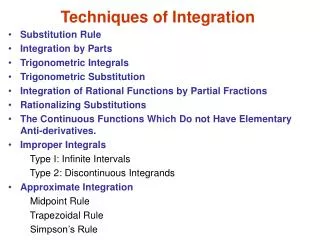
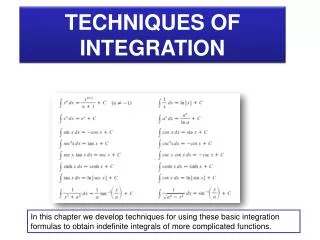
8 TECHNIQUES OF INTEGRATION In Section 5.6 we introduced substitution, one of the most important techniques of integration. In this section, we develop a second fundamental technique, Integration by Parts, as well as several techniques for treating particular classes of functions such as trigonometric and rational functions. However, there is no surefire method, and in fact, many important antiderivatives cannot be expressed in elementary terms. Therefore, we discuss numerical integration in the last section. Every definite integral can be approximated numerically to any desired degree of accuracy. Computer simulation of the Indonesian tsunami of December 26, 2004 (8 minutes after the earthquake), created using models of wave motion based on advanced calculus by Steven Ward, University of California at Santa Cruz.
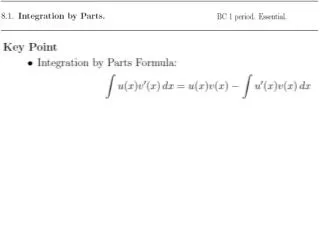
The Integration by Parts formula is derived from the Product Rule: Integration by Parts Formula
The Integration by Parts formula is derived from the Product Rule: Integration by Parts Formula Because the Integration by Parts formula applies to a product u(x)υ (x), we should consider using it when the integrand is a product of two functions.