Download
1 / 9
90 likes | 204 Vues
In this overview, we explore the key characteristics of solids, liquids, and gases, focusing on the role of intermolecular forces. It is crucial to understand how atoms and molecules in liquids move randomly due to weak intermolecular attractions, contrasting with the fixed positions of particles in solids. We also differentiate between types of solids: crystalline solids like table salt, which have a regular arrangement, and amorphous solids like glass, characterized by disorder. Discover how these properties affect the phases of matter and their defining characteristics.

E N D
CA Standards • Students know the atoms and molecules in liquids move in a random pattern relative to one another because the intermolecular forces are too weak to hold the atoms or molecules in a solid form.
Intermolecular Forces Forces of attraction between different molecules rather than bonding forces within the same molecule. • Dipole-dipole attraction • Hydrogen bonds • Dispersion forces
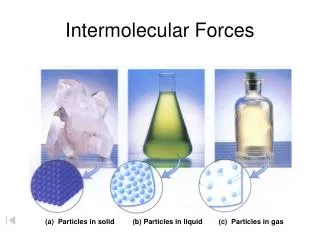
Forces and Phases • Substances with very little intermolecular attraction exist as gases • Substances with strong intermolecular attraction exist as liquids • Substances with very strong intermolecular (or ionic) attraction exist as solids
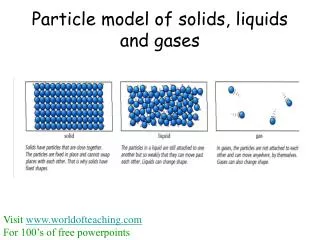
Phase Differences Solid– definite volume and shape; particles packed in fixed positions; particles are not free to move Liquid– definite volume but indefinite shape; particles close together but not in fixed positions; particles are free to move Gas– neither definite volume nor definite shape; particles are at great distances from one another; particles are free to move
Types of Solids • Crystalline Solids: highly regular arrangement of their components [table salt (NaCl), pyrite (FeS2)].
Unit Cell The smallest portion of a crystal lattice that shows the three-dimensional pattern of the entire lattice
Types of Solids • Amorphous solids: considerable disorder in their structures (glass and plastic).