SlideServe
Menu
Préférences
© SlideServe · v2026

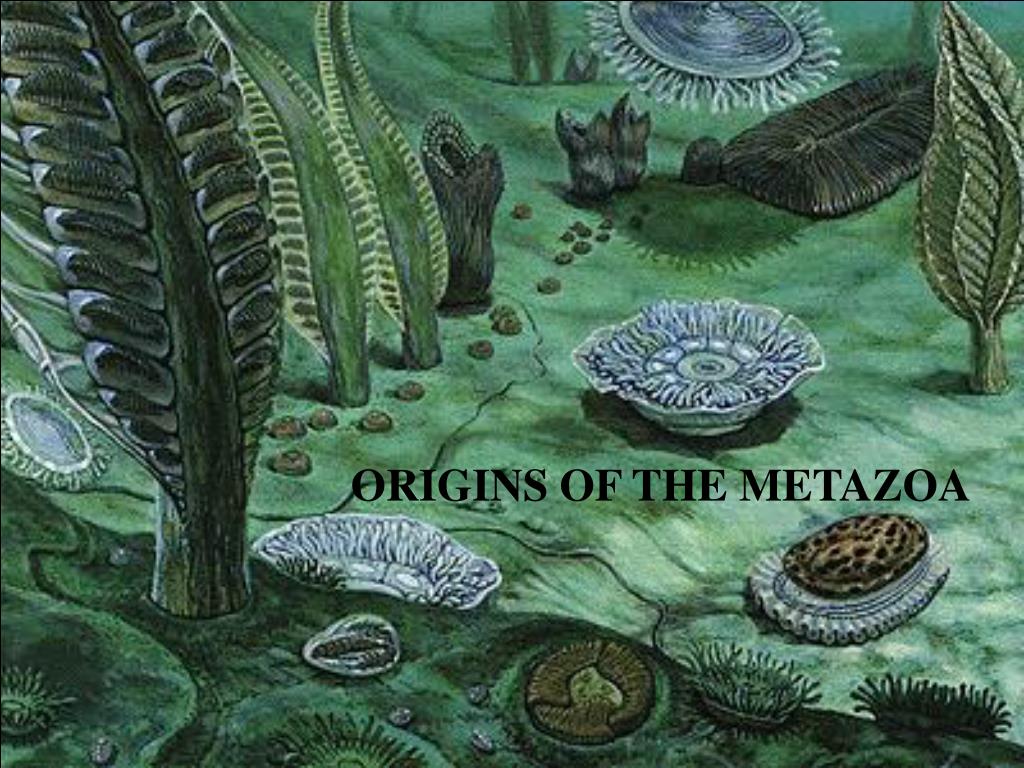
ORIGINS OF THE METAZOA

kiaria avatar
29 diapositives · 6.4K Views · Jul 20, 2014

ORIGINS OF THE METAZOA. Major evolutionary transitions. 1. Compartmentalization of replicating molecules - cells . 2. Coalescing of replicating molecules - chromosomes. 3. DNA and proteins as the genetic code. 4. Consolidate symbiotic cells to produce eukaryotic cells.
ORIGINS OF THE METAZOA - slide 1
01 / 29ORIGINS OF THE METAZOA
1 / 17

Télécharger la présentation

ORIGINS OF THE METAZOA
Une image / un lien ci-dessous est fourni (tel quel) pour télécharger la présentation

Politique de téléchargement : le contenu du site vous est fourni TEL QUEL pour votre information et votre usage personnel ; il ne peut être vendu, concédé sous licence ni partagé sur d’autres sites sans l’accord de son auteur.Le contenu vous est fourni TEL QUEL, pour votre information et votre usage personnel uniquement. Téléchargez la présentation en cliquant sur ce lien. Lors du téléchargement, si vous ne parvenez pas à télécharger une présentation, l’éditeur a peut-être supprimé le fichier de son serveur.Pendant le téléchargement, si vous ne parvenez pas à obtenir une présentation, le fichier a peut-être été supprimé par l’éditeur.

F I N

Plus de contenu associé

Transcription de la présentation
  1. ORIGINS OF THE METAZOA

  2. Major evolutionary transitions 1. Compartmentalization of replicating molecules - cells 2. Coalescing of replicating molecules - chromosomes 3. DNA and proteins as the genetic code 4. Consolidate symbiotic cells to produce eukaryotic cells 5. Sexual reproduction – production and fusion of haploid gametes 6. Evolution of multicellular organisms from unicellular ancestors 7. Establishment of social groups of discrete multicellular individuals

  3. ORIGINS OF THE METAZOA EARLY THEORIES Syncytial theory Metazoan ancestor - multinucleate, bilateral , ciliate protozoan • • • • • • • • • • • • • • • • • • • • • • • • Ciliated protozoan Hypothesized precursor • • • • • • • • • • • • Cell walls form around nuclei

  4. ORIGINS OF THE METAZOA EARLY THEORIES Colonial theory Metazoan ancestor - multinucleate, bilateral , ciliate protozoan Haeckel invagination introgression Metschnikoff

  5. What does more modern data tell us about how the Metazoa may have evolved?

  6. What does more modern data tell us about how the Metazoa may have evolved?

  7. Mat forming cyanophytes -layer of algae forms -sediment is trapped -a second algal layer grows - more sediment is trapped

  8. Stromatolites

  9. Distribution of multicellularity

  10. For multicellularity to develop need: 1. Cell adhesion 2. Cell –to-cell communication 3. Programmed cell death

  11. Types of Multicellular Development 1. Unicellular/clonal • Clonal development from spore or zygote • - all multicellular aquatic forms and most terrestrial • Genetic variation in cell lineage - low • Cell specialization by epigenetic change

  12. Types of Multicellular Development 2. Vegetative • Produce multicellular vegetative propagules 3. Aggregative - e.g. cellular slime molds

  13. 3. Aggregative Cellular slime molds

  14. 3. Aggregative Cellular slime molds

  15. Transition from unicellular to complex organisms

  16. Genetic consequences of different development patterns

  17. One pattern for development of multicellularity

  18. What are the candidates for the earliest multicellular animals Trichoplax Proterospongia Salinella Orthonectid

  19. Placozoan- the earliest animal? 1 mm

  20. Placozoan- the earliest animal? 1 mm

  21. Placozoan- the earliest animal? Their place in the evolutionary sequence Three current theories These are the sister group to all other Metazoans (Functional-morphology model) Gallertoid Flattened benthic planuloid Gallertoid with internal duct system Placozoa Sponges Cnidaria Ctenophora † †

  22. Placozoan- the earliest animal? Their place in the evolutionary sequence Three current theories These are the sister group to all other Metazoans (Functional-morphology model) Placozoa Sponges Eumetazoa

  23. Placozoan- the earliest animal? Their place in the evolutionary sequence Three current theories 2. Epitheliozoa Model - Considers shared characteristics -desmosomes -ventral gland cells Sponges Placozoa Epitheliozoa Eumetazoa Some molecular support

  24. Placozoan- the earliest animal? Their place in the evolutionary sequence Three current theories 2. Eumetazoa Model - Molecular analysis Sponges Ctenophora Cnidaria Eumetazoa Placozoa Bilateria Problems: statistically weak and ignores structure

  25. What about the sponges?

  26. Sponge Structure - Specialized cells - No true tissues

  27. Schulze et al 1999. Proc.Roy.Soc.Lond.B. 266: 63

  28. Schulze et al 1999. Proc.Roy.Soc.Lond.B. 266: 63

  29. Schulze et al 1999. Proc.Roy.Soc.Lond.B. 266: 63