Quotation vs. Paraphrase
This presentation focuses on the crucial use of information in academic work, emphasizing the importance of proper quotation and paraphrasing techniques. It outlines how direct quotations require attribution through footnotes and bibliographies, while paraphrasing demands acknowledgment of the source without using quotation marks. Understanding these concepts is essential for maintaining academic honesty, preserving the integrity of scholarship, and avoiding plagiarism. This guide serves as a foundational resource for students at Austin Seminary and beyond in mastering effective sourcing strategies.

Quotation vs. Paraphrase
E N D
Presentation Transcript
Quotation vs. Paraphrase 12 Basic IQ Skills
IQ: FRAU • Find • Retrieve • Analyze • Use This presentation is about the USE of information in your academic work.
Why Should I Care? • Christians value honesty • Scholars value accuracy and receiving credit for their ideas • So, the kind of work you do at Austin Seminary requires attention to how you use sources in your work
Living in a Tradition of Thought • Many of My New Ideas build on the words of others • In academic work, I explicitly note my dependence on the words and ideas of others • Not to do so is plagiarism, an ethical violation
Plagiarism: A Bad Thing • Plagiarism is the lack of explicit acknowledgement of the ideas or phrases of others • Austin Seminary expects students to acknowledge dependence by using footnotes and appending bibliographies to academic work
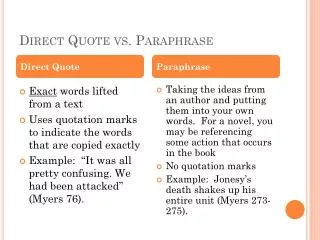
Directly Quoting • A direct quotation uses the exact words of another in unaltered form. • Here’s a quote: • On a sultry day in July of the year 1505 a lonely traveler was trudging over a parched road on the outskirts of the Saxon village of Stotternheim.
Directly Quoting By rule you must: • Place these words in quotation marks in your paper • Include a footnote documenting the source • Add the source to the bibliography at the end of your paper
Directly Quoting “On a sultry day in July of the year 1505 a lonely traveler was trudging over a parched road on the outskirts of the Saxon village of Stotternheim.” Footnote: Roland H. Bainton, Here I Stand: A Life of Martin Luther (Nashville: Abingdon, 1950), 21. In bibliography: Bainton, Roland H. Here I Stand: A Life of Martin Luther . Nashville: Abingdon, 1950.
Directly Quoting • In summary: • Use quotation marks • If the quote is 5 or more lines, make it a block quote using Turabian 25.2.2 • Create a footnote • Add the work cited to bibliography
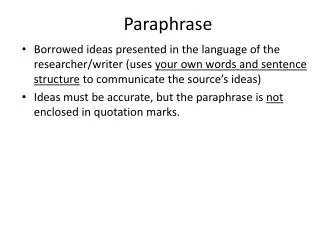
Paraphrasing • A paraphrase does not use the exact words of another • A paraphrase, however, does make use of the ideas of another • Austin Seminary expects you to acknowledge your indebtedness via appropriate footnotes and bibliography
Paraphrasing Here’s a paraphrase: • David Jensen argues on theological grounds that work is a fundamental human right, and that government policies should promote education that leads to employment.
Paraphrasing • Therefore, by rule: • Do not use quotation marks. • Write a footnote: David H. Jensen, Responsive Labor: A Theology of Work (Louisville: Westminster John Knox Press, 2006), 105-106.
Paraphrasing • In bibliography: Jensen, David H. Responsive Labor: A Theology of Work. Louisville: Westminster John Knox Press, 2006.
Paraphrasing • You must acknowledge your source, even when paraphrasing • Do not use quotation marks • Do use a footnote • Do include the source document in your bibliography
Paraphrasing • Good practice: paraphrases should sound like YOU interpreting the words of others • Suggestion: Use direct quotes sparingly, or use a single long quote and then comment on it • Honor the source in a footnote
Summary • Copying of the words of others (quotations) and putting the ideas of others in your own words (paraphrases) require you to: • Follow proper quoting rules • Use footnotes • Add cited source to bibliography
Questions? libraryiq@austinseminary.edu