Polynomial Representations of Integers
90 likes | 214 Vues
This lesson focuses on base notation for representing integers in different numeral systems, specifically highlighting how numbers are written in base b notation. It covers the significance of each digit and the calculation of a number's value. Examples include converting the hexadecimal number 3D7B16 into base 10 and the conversion of 4387 into base 6. Additionally, it explores binary addition, demonstrating how computers perform arithmetic using half adders. The lesson concludes with homework exercises for further practice.


Polynomial Representations of Integers
E N D
Presentation Transcript
Polynomial Representations of Integers Lesson 4.7
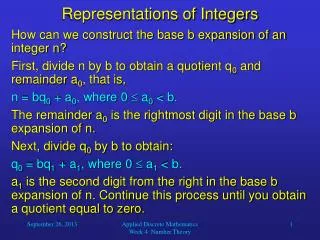
Base Notation • A number is written in base b notation , (dn, dn-1,dn-2,…,d1,d0)b Iff each digit di is a particular integer from 0 through b – 1, and the value of the number is Dnbn + dn-1bn-1+…+d1b1 + d0b0
Example 1 • Write 3D7B16 in base 10 3(163)+ 13(162)+7(16) + 11(1) 12288+ 3328+ 112+ 11 15739
Example 2 • Write 4387 in base 6. 4387 ÷ 6 = 731 r. 1 731÷ 6 = 121 r. 5 121÷ 6 = 20 r. 1 20 ÷ 6 = 3 r. 2 3 ÷ 6 = 0 r. 3 So, 32,151
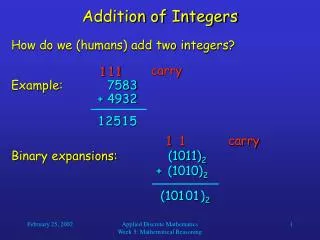
Example 3 • Perform the base 2 addition below. 1 0 0 1 1 + 1 1 0 0 0 1 1 0 1 0 1 1
How your computer adds…Half Adder – binary ones digits Sum digit and and p q or not carry digit
Sum digit p q and and carry digit or not
Homework Pages 268 – 269 3, 6 , 8 , 11 – 13, 18