### Enhancing IT Services Through ITIL: Insights from the University of Utah Help Desk Conference ###
This presentation from the University of Utah's Help Desk Conference on October 26, 2007, discusses the critical role of ITIL (Information Technology Infrastructure Library) in improving IT service management. It covers how ITIL aligns IT services with business needs, enhances service quality, reduces costs, and boosts customer satisfaction. Key topics include service delivery, service desk functions, incident and problem management, and the importance of having a structured approach for change and release management. The session emphasizes ITIL as a best-practice framework for effective IT service delivery. ###

### Enhancing IT Services Through ITIL: Insights from the University of Utah Help Desk Conference ###
E N D
Presentation Transcript
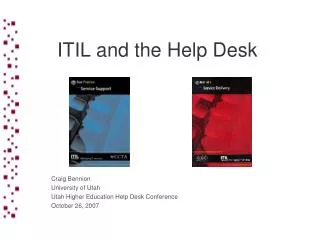
ITIL and the Help Desk Craig Bennion University of Utah Utah Higher Education Help Desk Conference October 26, 2007
Why Service Management • Align IT services with business needs • Improve quality of IT services • Reduce long-term costs • Improve customer and user satisfaction
ITIL and Service Management Quiz What is the role of ITIL in Service Management? • To provide an approach based on the best examples taken from practice • To serve as the international standard for Service Management • To serve as the standard model for IT provision • To serve as a theoretical framework for process design
ITIL and Service Management Quiz What is the role of ITIL in Service Management? • To provide an approach based on the best examples taken from practice • To serve as the international standard for Service Management • To serve as the standard model for IT provision • To serve as a theoretical framework for process design
Information Technology Infrastructure Library A process approach to Service Management Service Delivery The Business Perspective Applications Management Security Management ICT Infrastructure Service Support Planning to Implement Service Management
Help Desk? So where’s the Help Desk in ITIL?
Service Delivery Service Level Financial Capacity Availability Service Continuity Service Support The Service Desk Incident Problem Configuration Change Release Information Technology Infrastructure Library
Help Desk Resolve incidents quickly Ensure no incidents are lost Service Desk Resolve incidents quickly Ensure no incidents are lost Single Point Of Contact (SPOC) for all IT services Customer advocate Interface to other IT service processes Help Desk vs Service Desk
Service Delivery Service Level Financial Capacity Availability Service Continuity Service Support The Service Desk Incident Problem Configuration Change Release Information Technology Infrastructure Library
Service Level Management • Maintain and improve IT service quality • Monitor and report on IT services • Eradicate poor service Tools • Service Catalog • Service Level Agreement
Financial Management • Provide cost-effective stewardship of assets and resources • Identify the costs to provide a service • Cost justify changes to IT services
Capacity Management • Understand business requirements, IT operations, and IT infrastructure • Ensure current and future capacity and performance are met cost effectively
Service Continuity Management • Ensure technical and service facilities can be recovered within required business time lines
Availability Management • Optimize the capability of the IT infrastructure • Deliver cost effective services • Ensure availability of IT services according to business needs and objectives
Incident Management • Restore normal service as quickly as possible • Minimize adverse impact on business • Ensure service quality and availability are maintained
Problem Management • Minimize adverse impact of incidents and problems on the business • Identify infrastructure errors and provide work-arounds and fixes • Prevent recurrence of incidents
Configuration Management • Account for IT assets and configurations • Provide accurate information on configurations • Verify configuration records • Support Incident, Problem, Change, and Release Management
Change Management • Ensure a standard procedure to implement changes • Ensure prompt handling of changes • Minimize impact of changes related incidents on service quality • Improve day-to-day operations
Release Management • Plan and oversee successful rollout of hardware, software and changes • Ensure changes are tested • Communicate changes • Ensure hardware and software being changed is traceable and secure