Exploring Bacteria and Protists: Classification, Movement, and Impact on Life
This lesson delves into the fascinating world of bacteria and protists, two essential groups of microbes. Bacteria are classified by their shapes—spiral (spirillum), rod (bacillus), and spherical (coccus)—and can be both helpful, by producing antibiotics and vitamin K, and harmful, as disease-causing agents. Protists, primarily single-celled organisms residing in moist environments, are categorized by movement: Euglena moves with flagella, Paramecium uses cilia, and Amoeba relies on pseudopods. Both groups play significant roles in ecosystems, food production, and human health.

Exploring Bacteria and Protists: Classification, Movement, and Impact on Life
E N D
Presentation Transcript
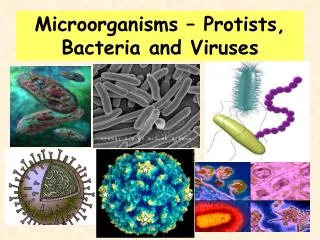
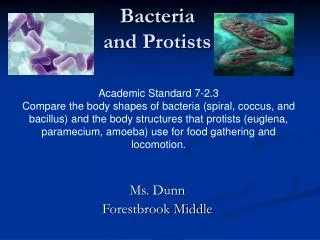
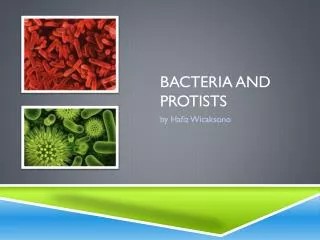
Bacteria • Classification: by the shape of the cell • Spirillum: bacterium that has a spiral shape • Bacillus: a rod-shaped bacterium • Coccus: a round or spherical bacterium
Bacteria • Helpful: • Produce antibiotics • Produce vitamin K (live in your intestines) • Harmful: • Can cause disease • Produce toxins (poison)
Protists • Classification: by how they move and get food • Most are single-celled and live in moist environments
Euglena • A single-celled protist that uses one or more flagella to move • Flagella: a whip-like structure that moves back and forth to push a euglena through water • Have chloroplasts and can photosynthesize • Can also get food by eating other organisms
Paramecium • A single-celled protist that uses cilia to move • Cilia: tiny hair-like structures on the outside of the paramecium cell • Uses cilia to get food and to move
Amoeba • Single-celled protistthat uses pseudopods to move and to trap food • Pseudopods: a temporary, finger-like structure that is an extension of the cell
Protists • Helpful: • Help produce toothpaste, pudding, ice cream • In fertilizers • Harmful: • Can cause malaria • Can cause potato blight
Lesson Essential Questions • What are some of the differences between the cells of the two groups of microbes? • Bacteria: single-celled, classified by shape • Protists: live in moist environments, classified by how they move and obtain food
Lesson Essential Questions • How do the different protists move and obtain energy? • Euglena: move with flagella; photosynthesize or consume other organisms • Paramecium: move with cilia; use cilia to help consume other organisms • Amoeba: move with pseudopods; use pseudopods to consume other organisms