SlideServe
Menu
Préférences
© SlideServe · v2026

Enhancing Psychological Flexibility in Social Work: Connecting with Clients and Communities

kimi avatar
27 diapositives · 429 Views · Jul 30, 2014

This exploration emphasizes the role of psychological flexibility in social work, focusing on how it can enhance connections with clients and communities. By understanding social work values—such as commitment to human well-being, client empowerment, and advocacy for social justice—we can better address the needs of vulnerable populations. The approach encourages social workers to facilitate change by addressing inner thoughts and feelings contextually, fostering both personal and community resilience. Together, we can make meaningful impacts despite systemic challenges.
Enhancing Psychological Flexibility in Social Work: Connecting with Clients and Communities - slide 1
01 / 27Enhancing Psychological Flexibility in Social Work: Connecting with Clients and Communities
1 / 17

Télécharger la présentation

Enhancing Psychological Flexibility in Social Work: Connecting with Clients and Communities
Une image / un lien ci-dessous est fourni (tel quel) pour télécharger la présentation

Politique de téléchargement : le contenu du site vous est fourni TEL QUEL pour votre information et votre usage personnel ; il ne peut être vendu, concédé sous licence ni partagé sur d’autres sites sans l’accord de son auteur.Le contenu vous est fourni TEL QUEL, pour votre information et votre usage personnel uniquement. Téléchargez la présentation en cliquant sur ce lien. Lors du téléchargement, si vous ne parvenez pas à télécharger une présentation, l’éditeur a peut-être supprimé le fichier de son serveur.Pendant le téléchargement, si vous ne parvenez pas à obtenir une présentation, le fichier a peut-être été supprimé par l’éditeur.

F I N

Plus de contenu associé

Transcription de la présentation
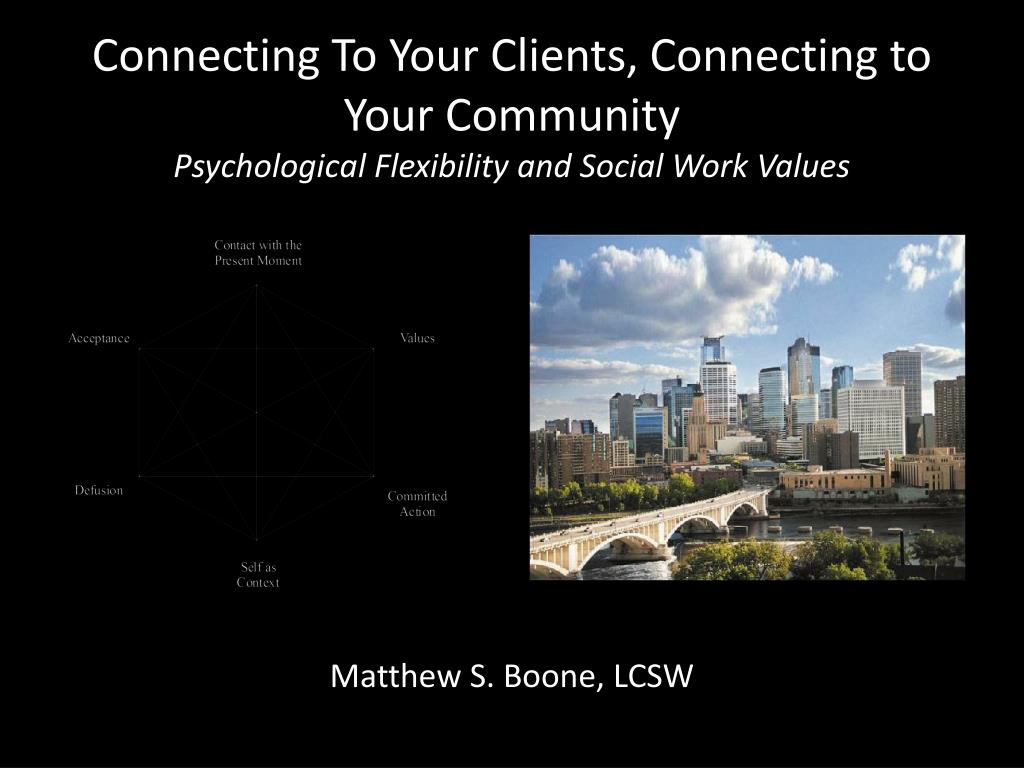
  1. Connecting To Your Clients, Connecting to Your CommunityPsychological Flexibility and Social Work Values Matthew S. Boone, LCSW

  2. Social work has a distinctive focus on serving the needs of people who are vulnerable, oppressed, and living in poverty Reamer, 1999

  3. Preamble to NASW Code of Ethics Social Work Values • Commitment to enhancing human well-being and helping meet the basic human needs of all people • Client empowermentand client strengths • Service to people who arevulnerable and oppressed • Focus on individual well-being in a social context • Promotion of social justice andsocial change • Sensitivity to cultural and ethnic diversity NASW, 2008; Reamer, 1999

  4. Helping people adapt to their environments Helping environments adapt to people

  5. This problem is too big to change

  6. Things have always been this way

  7. What difference can one person make?

  8. I just don’t have the time

  9. Someone else will do it

  10. It’s too much work to make a difference

  11. Things will change whether or not I do anything

  12. I have to figure out exactly what I think before I act

  13. If I begin to care, I will get way too angry

  14. Who am I to think I have anything to say about this issue?

  15. I have enough to do for myself without having to fix things for others

  16. I’m much better at serving individuals – there’s just so much more you can do

  17. It just seems so hopeless sometimes

  18. language thoughts feelings

  19. Addressing context to facilitate change A traditional social work intervention might include changing context by helping a client get access to needed resources or by effecting larger scale systems change (e.g., policies, political action) ACT changes the context of thoughts and feelings rather than trying to change the thoughts and feelings themselves • e.g., undermining the context of literality supported by the verbal community (defusion context) • e.g., treating private experiences as welcome guests (acceptance context)

  20. Describe a problem • Think of a problem at the group, organizational, community, or societal level which is important to you • One you would like to do something about • But one about which you have thus far notdone as much as you would like • Describe it to your partner for the next few minutes • Listeners: as your best listening selves, elicit values related to this problem

  21. Your struggling self

  22. Your best self

  23. Eyes Closed

  24. FlexibleSelfing

  25. Commitment