
Understanding Square Roots: Concepts and Examples
E N D
Presentation Transcript
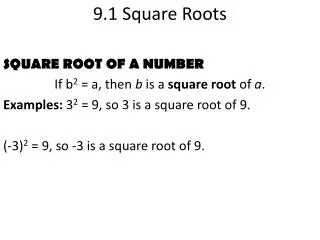
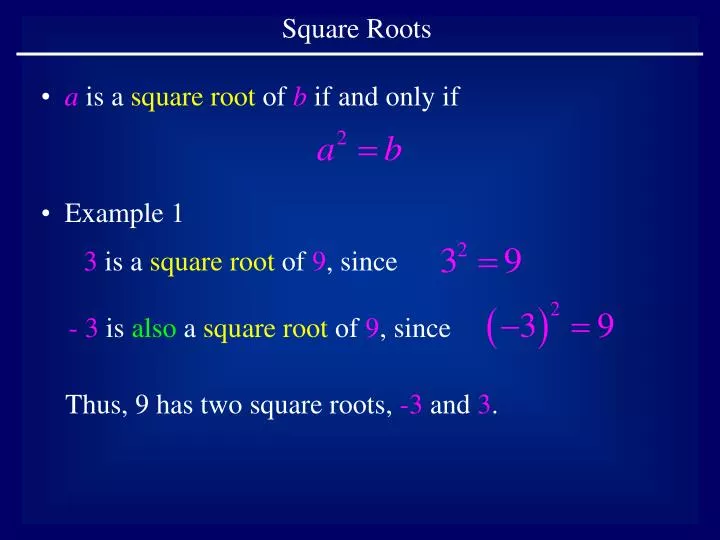
3 is a square root of 9, since - 3 is also a square root of 9, since Square Roots • a is a square root of b if and only if • Example 1 Thus, 9 has two square roots, -3 and 3.
Example 2 The number 0 has only one square root, which is 0 since
Sometimes there are no square roots of a number. • Example 3: There are no square roots of –16 since there are no numbers a such that Note that neither4 nor – 4 will work.
Radical notation Radical symbol Square root of a The expression that appears under the radical sign, a in this case, is called the radicand. When radical notation is used, the result is the principalsquare root, which is the non-negative root.
Simplify: • Example 4 There are two square roots of 25, - 5 and 5. The principal second root is the non-negative root, or 5. Therefore,
Example 5 Simplify Reasoning Note that while it is also true that we want the principal (nonnegative) root.
Simplify Reasoning • Example 6
Simplify Reasoning is undefined. • Example 7
Simplify Reasoning • Example 8