Download
1 / 31
310 likes | 423 Vues
This research explores the coherence of neuronal movements in the brain by analyzing current density vectors (CDVs). By leveraging techniques like EEG, we classify these vectors into clusters based on their spatial positions and orientations while detecting patterns that indicate synchronized activity. We propose methods to refine classifications and analyze the similarities and velocities of these vectors, assessing their unison in movement. Our findings aim to provide insights into the complex dynamics of neuronal communication, paving the way for further validation and model refinement.

E N D
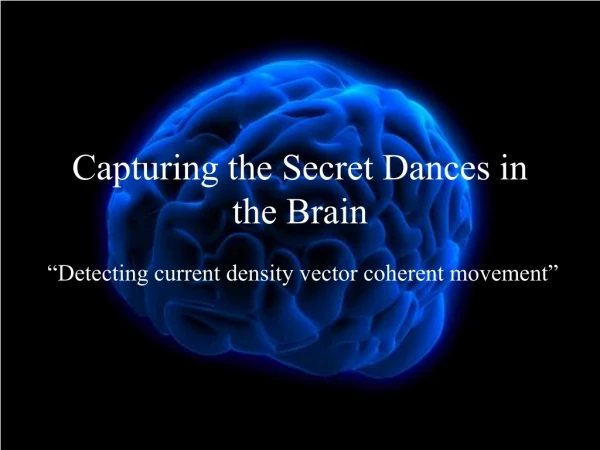
Capturing the Secret Dances in the Brain “Detecting current density vector coherent movement”
Cerebral Diagnosis A problem proposed by:
The Brain The most complex organ 85 % Water 100 billion nerve cells Signal speed may reach upto 429 km/hr
Neuronal Communication • Neurons communicate using electrical and chemical signals • Ions allow these signals to form
Brain Imaging Techniques EEG MEG fMRI
Electroencephalogram • Electrodes on scalp measure these voltages • An EEG outputs the voltage and the locations
EEG of a Vertex wave from Stage I sleep Voltage time
Inverse Problem Solving using eLoreta • The EEG collects the amplitudes • Inverse Problem Solving allows the computation of an electrical field vector • Output is current density vectors at voxels
Problems Goal: to capture certain behaviour common to groups of vectors • Problem A: • Classify the vectors according to orientations and spatial positions • Problem B: • Classify the vectors that dance in unison
Problem A • Classify the vectors according to orientations and spatial positions Input: Top 5% of Activity Normalize the data onto a unit sphere Classification Output: Clusters
Classification • Initialization: Statistical algorithm to group into 4 clusters as suggested by the data. • Refinement: Partition each cluster into subsets of spatially related voxels via where x and y are physical coordinates of a pair of voxels.
Problem A-Nataliya Next step: Refinement of clusters based on orientation. pairwise inner product < i, j > 5 5 2 6 2 6 4 1 4 1 3 3 Separation criterion: inner product >tol (e.g., tol=0.8).
Problem A-Two Layer Classification • First, classify the voxels in connected spatial neighborhoods • Second, refine each neighborhood according to orientations
Problem B Classify the vectors that dance in unison
Problem B Doing the same thing at the same time? Doing different things at the same dance? Dance in Unison???
Problem B • Spatial proximity, similar orientation, similar velocity • Same two-layer classification algorithm! • Critera for refining spatial clusters : orientation, velocity Algorithm 1
Problem B The proposed distance that determines current density vectors dancing in unison is the inner product of normalized differences diffi diffj i j n time frames The clustered vectors move along relatively the same trajectory with variation controlled by a user defined tolerance parameter.
Problem B: Varvara (Clustering Using Cosine Similarity Measure) v
Problem B: Varvara (Clustering Using Cosine Similarity Measure) Input-Data Compute Cosine for any two consecutive times for each voxel Test condition 1 Dancing in unison means Member of a cluster Test condition m Member of a cluster End
Problem B: Varvara (Clustering Using Cosine Similarity Measure)
Conclusions: • In this project we tried to observe whether or not any pattern exists in the CDVs data at a fixed time, and over a time interval. • During this very short period of time we were able to solve the two problems in more than one way. • Data whose magnitudes are more that 95% of the maximum magnitudes in the given range were observed. • Next step: validation with other random data, refine models that already work