Comprehensive Review for Chemistry I Final Exam
100 likes | 236 Vues
Prepare for your Chemistry I final exam with this comprehensive review covering compound naming, chemical formulas, dimensional analysis, balancing equations, and other key concepts. This guide includes tasks such as writing formulas for specific compounds, translating chemical equations into word equations, and solving problems involving isotopes and combustion reactions. Practice problems also focus on determining empirical and molecular formulas from percent compositions. Sharpen your skills and boost your confidence to excel in your exam!


Comprehensive Review for Chemistry I Final Exam
E N D
Presentation Transcript
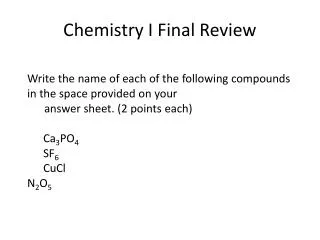
Chemistry I Final Review • Write the name of each of the following compounds in the space provided on your • answer sheet. (2 points each) • Ca3PO4 • SF6 • CuCl • N2O5
Chemistry I Final Review • Write the chemical formula that represents each of the following compounds on the space provided on your answer sheet. (2 points each) • carbon disulfide • potassium nitride • iron (II) carbonate • dinitrogen monoxide
Chemistry I Final Review Perform the following conversion using dimensional analysis: 5 days to milliseconds. Show your work in dimensional analysis and express your answer to the correct number of significant digits.
Chemistry I Final Review Translate the following chemical equation into a word equation: (4 points) CuCl2(aq) + Mg(s)→ MgCl2 (aq) + Cu(s)
Chemistry I Final Review • Iron(III) hydroxide + sodium sulfide yield sodium hydroxide + iron (III) sulfide.
Chemistry I Final Review • Balance the following problems in the space provided. Show your work. • Ca (s) + H3PO4→ Ca3(PO4)2 + H2 • HNO3 + Mg(OH)2→ Mg(NO3)2 + H2O
Chemistry I Final Review Magnesium has three naturally occurring isotopes: 78.70% of magnesium atoms exist as magnesium-24 (23.9850 amu), 10.03% exist as magnesium-25 (24.9858 amu) and 11.17% exist as magnesium-26 (25.9826 amu). What is the average atomic mass of magnesium? (Show your work)
Chemistry I Final Review Propane gas, C3H8, is the gas that we use in our labs when we ignite the Bunsen burner. In the complete combustion reaction of 10-grams of propane 30 g of oxygen are produced. How many molecules of oxygen are released in this reaction?
Chemistry I Final Review A component of protein called serine has an approximate molar mass of 100 g/mol. If the percent composition is as follows, what is the empirical and molecular formula of serine? (6 points) C= 34.95% H=6.844% O= 46.56% N=13.59%