Understanding Living Things: Classification, Needs, and Characteristics
370 likes | 514 Vues
Dive into the fascinating world of living organisms! This chapter explores the fundamental concepts of what constitutes life, including the definition of living things, their key characteristics, and the various needs that sustain them. Discover the processes of growth and development, the principles of classification, and the significance of taxonomy in organizing life forms. Learn about the essential requirements for survival and the distinction between autotrophs and heterotrophs. With insights into naming systems and domains, this review offers a comprehensive overview of biological organization.


Understanding Living Things: Classification, Needs, and Characteristics
E N D
Presentation Transcript
Chapter 2-1, 2-2 Living Things & Classificaion
Another Igneous Scientificus (a.k.a. Iggy) Review
What is Life? What’s in a Name? Living Things Needs of Living Things Let’s Get Organized
What is Life? • Any living thing organism
What is Life? • A change in an organism’s surroundings stimulus
What is Life? • An organism’s reaction to a change in its environment response
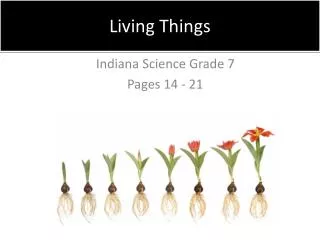
What is Life? • The process in which an organism becomes larger growth
What is Life? • Change that occurs during an organism’s life that makes it more complex development
What is Life? • Name four characteristics of living things Made of cells Have similar chemicals Use energy Respond to surroundings Grow and develop Reproduce
Living Things • Name given to a single-celled organism unicellular
Living Things • Name given to organisms made of many cells multicellular
Living Things • Mistaken idea that living things can come from nonliving sources Spontaneous generation
Living Things • Process by which living things arise from living things reproduction
Living Things • Basic unit of structure and function in an organism cell
Let’s Get Organized • Process of grouping things based on similarities classification
Let’s Get Organized • The reason scientists organize living things into group So that organisms are easier to study
Let’s Get Organized • He developed the naming system that groups organisms Carolus Linnaeus
Let’s Get Organized • The study of how living things are classified taxonomy
Let’s Get Organized • The highest or broadest level of classification domain
Let’s Get Organized • Lowest level of organization in which similar organisms can mate to produce offspring species
Let’s Get Organized • The domain (s) that include(s) only prokaryotes Bacteria and Archaea
Let’s Get Organized • The domain (s) that include(s) only eukaryotes Eukarya
Let’s Get Organized • The kingdoms that include both uni- and multicellular organisms? Protists and Fungi
Needs of Living Things • All living things need this substance to survive water
Needs of Living Things • Name for an organism that makes its own food autotroph
Needs of Living Things • Name of an organism that can’t make its own food heterotroph
Needs of Living Things • Source of energy for all living things food
Needs of Living Things • Name the four needs of all living things Water, food, living space, and stable internal conditions
Needs of Living Things • Organism’s ability to maintain stable internal environment homeostasis
What’s in a Name? • Organism whose cells lack a nucleus prokaryote
What’s in a Name? • Organism whose cells have a nucleus eukaryote
What’s in a Name? • The two word naming system for organisms binomial nomenclature
What’s in a Name? • The first word in the naming system refers to this classification level Genus
What’s in a Name? • The second word in the naming system refers to this classification level Species
What’s in a Name? • The three domains of living things Bacteria, archaea, eukarya
What’s in a Name? • Domain that we belong to eukarya