Understanding Electric Potential and Field Equations in 3D Space
This resource explains the concepts of electric potential and electric fields as explored by Alan Murray from the University of Edinburgh. It discusses the relationship between electric fields and potential difference, including how to calculate work done when moving a charge in an electric field. Visual analogies and mathematical expressions are presented to illustrate gravitational potential energy and contour lines. The text covers key aspects of electric fields (E) and potential (V), providing a comprehensive understanding of these fundamental physics concepts.


Understanding Electric Potential and Field Equations in 3D Space
E N D
Presentation Transcript
Potential Alan Murray
V 0 |E| 0 Potential … Start Simply … V Remember the capacitor E = -V/d E=-(rate of changeof V with distance) Alan Murray – University of Edinburgh
E = -V/d • Should really be E = -dV/dx • And if V = Mx+c, dV/dx = M = constant • Then E = -M as shown • In 3D, dV/dx becomes(dV/dx, dV/dy, dV/dz) = ÑV, so • E = -ÑV = -(dV/dx, dV/dy, dV/dz) E = -ÑV Alan Murray – University of Edinburgh
300M 250M 200M 150M 100M Potential : Analogy These contour lines are lines of equal gravitational potential energy mgh Where they are close together, the effect of the gravitational field is strong The field acts in a direction perpendicular to the countoursand it points in a negative direction … (i.e. that’s the way you will fall!) Alan Murray – University of Edinburgh
Potential - comments • Walking around a contour expends no energy • In a perfect world • i.e. no-one moves the hill as you walk! • Walking to the top of the hill and back again expends no energy • In a perfect world • i.e. – the hill stays still and you recoup the energy you expend while climbing as you descend (using your internal generator!) Alan Murray – University of Edinburgh
5V Metal electrode 5V 1V Metal electrode E-Fieldlines 2V 3V 0V 4V Electric Fields and Potentials are the Same Voltage contours Alan Murray – University of Edinburgh
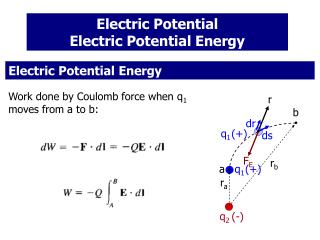
5V 1C 1C 1C 1C Metal electrode 5V Metal electrode E-Fieldlines 0V Potential Difference : Formal Definition (L) The Potential Difference (Voltage)between a and b is the –the workdone to move a 1C chargefrom a to b b x a x Alan Murray – University of Edinburgh
Potential Difference : Formal Definition (L) • The Potential Difference (Voltage)between a and b is the –the workdone to move a 1C chargefrom a to b • In 1D, Work = -Fd • In 3D, Work = -F.dl • Force = F = Q´E =+1´E = E • Work done = -E.dl • Total Work done = -òabE.dl Alan Murray – University of Edinburgh
E E E E E E E E E E E E E dl dl dl dl dl dl dl dl dl dl dl dl dl Line integral …revision E Alan Murray – University of Edinburgh
Potential Difference = -òabE.dl • òabis a line integral • In general mathematics, the value of a line integral depends upon the path dl takes from a to b • In this potential calculation, the path does not matter • So : choose a “convenient” path Alan Murray – University of Edinburgh
1C Q E Potential Difference : Worked Example – Point charge Q (b) Place a 1C charge at (a) Move it to (b) Work done in this movementis the potential difference(voltage) between (a) and (b) (a) Alan Murray – University of Edinburgh
1C (a) E E dr dl E Potential Difference : Worked Example – Point charge Q Choose this path From (a)-(c), no workis done (ra=rc) E and dl perpendicular (b) x From (c)-(b), work isdone E and dr parallel E = Qâr 4pe0r2 E (a) (c) x Q Alan Murray – University of Edinburgh
Potential Difference : Worked Example – Point charge Q Correct! – if Q>0, we have moved a positive charge along a field line – work is done by the electric field, so Vab<0 Alan Murray – University of Edinburgh
Potential Difference (PD) in an Electric Field : Procedure • Write an expression for the electric field E • Define a path between the points whose PD you want to calculate • Select a “sensible” path • Write down -òabE.dlfor this path and field • If you have chosen a sensible path, this will not be a tricky integral Alan Murray – University of Edinburgh
Potential - Footnote • Once you have decided where the “zero” of potential is, all other potentials are calculated with respect to that zero • cf – choice of “zero” of height • One conventional physicist’s choice is to set point (a) to¥ • Vab is then the energy expended in moving a 1C charge from ¥ to point b, and Vb is then the absolute potential at point b Alan Murray – University of Edinburgh