Download
1 / 10
100 likes | 223 Vues
This research explores the relationship between social media usage and mental health among teenagers. The aim was to determine how various social media interactions influence self-esteem, anxiety, and depression levels. Drawing on existing literature, the study identifies significant trends and statistics linking high social media engagement with negative mental health outcomes. The hypothesis suggested that increased social media use correlates with poorer mental health. Results indicate a clear connection, providing insights for parents, educators, and mental health professionals.

E N D
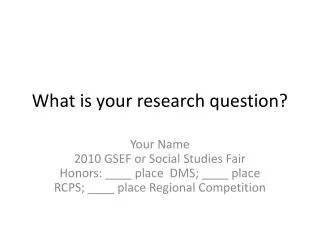
What is your research question? Your Name2010 GSEF or Social Studies FairHonors: ____ place DMS; ____ place RCPS; ____ place Regional Competition
Research Question While this is displayed, discuss why you chose this topic.
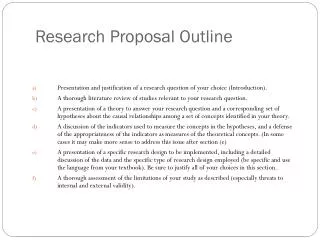
Review of the Literature • This is where you tell what others had already discovered about your topic or a related topic. • Summarize your background research. • Bullet each important fact ,statistic, or detail. • Make sure the connection to your question is evident.
Hypothesis Based on my research, it was expected that…
Materials • List each item used, with quantities. • Bullet all items.
Method • List each procedure, in order • Be specific • Remember that others should be able to replicate your experiment based on your detailed narrative • Mention variables
Results • What did you find out? • Use statistics to share your data. • In this section, you may freely use numerals and percents. • Be thorough in your analysis. • You may add graphs and tables to use as visuals; they will be on additional slides.
Conclusion • Was your hypothesis correct (supported) by your research? • How would the knowledge gained from this project apply to everybody?
Discussion • Having completed the process, are there new questions that have surfaced? • Would you make any changes to your research methodology? • What did you learn from the research process?
References Copy your reference page here. Do not use bullets. Do use a hanging indent.