Comprehensive Overview of Ecology: Principles, Organisms, and Biomes
This document provides an extensive overview of ecological principles and concepts, detailing the interactions among organisms and their abiotic environment. It covers the essential components of ecology, such as individual, population, community, ecosystem, and biosphere levels. Additionally, it highlights the dynamics of populations, communities, and ecosystems, including energy flow, nutrient cycles, and biomes of North America, with a focus on deserts and grasslands. Ideal for educators and students seeking a deeper understanding of ecological relationships and environmental impacts.


Comprehensive Overview of Ecology: Principles, Organisms, and Biomes
E N D
Presentation Transcript
KAREN LANCOUR National Bio Rules Committee Chairman karenlancour@charter.net 2009 ECOLOGY (B&C)
EVENT COMPONENTS • Ecology Content – 2009 • Principles of Ecology (about 50 %) • Deserts and Grasslands of North America (about 50%) • Process skills in data, graph and diagram analysis • Event parameters • Non-programmable calculators • No reference materials
ECOLOGY AND ABIOTIC ENVIRONMENT ECOLOGY – how organisms interact with one another and with their environment ENVIRONMENT – living and non-living components • ABIOTIC – non-living component or physical factors as soil, rainfall, sunlight, temperatures • BIOTIC – living component are other organisms.
ECOLOGICAL ORGANIZATION • INDIVIDUAL– individual organisms • POPULATION– organisms of same species in same area (biotic factors) • COMMUNITY– several populations in same area (biotic factors) • ECOSYSTEM– community plus abiotic factors • BIOSPHERE– all ecosystems on earth
ECOLOGY OF INDIVIDUALS • Homeostasis – delicate balance • Components • Physiological Ecology • Temperature and Water Balance • Light and Biological Cycles • Physiological Ecology and Conservation
ECOLOGY OF POPULATIONS • Properties of populations • Patterns of distribution and density • Intraspecific competition • Population dynamics • Growth and regulation • Altering population growth • Human impact
Survival Curves • Survivorshipis the percentage of remaining survivors of a population over time; usually shown graphically. Type I survivorship curve: most individuals live out their life span and die of old age (e.g., humans). Type II survivorship curve: individuals die at a constant rate (e.g., birds, rodents, and perennial plants). Type III survivorship curve: most individuals die early in life (e.g., fishes, invertebrates, and plants).
ECOLOGY OF COMMUNITIES • Closed vs. Open communities • Closed – sharp boundaries • Open – Lack boundaries • Species abundance and diversity • Trophic Structure of Communities • Food chains • Food web • Trophic pyramid
INTERACTIONS AMONG SPECIES • Interactions • Interspecific competition • Predation • Exploitation • Symbiosis
Types of Species Interactions • Neutral – two species do not interact • Mutualism – both benefit • Commensalism – one benefits, other neutral • Parasitism – one benefits, one harmed but not killed • Predation – one benefits, other killed
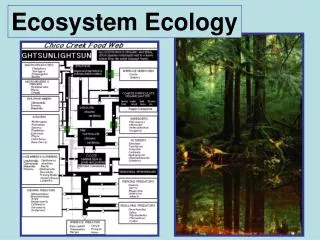
Food Chain • rose plantaphidsbeetlechameleon hawk • Producer • 1st order Consumer or Herbivore • 2nd order Consumer or 1st order Carnivore • 3rd order Consumer or 2nd order Carnivore • 4th order Consumer or 3rd order Carnivore • Decomposers – consume dead and decaying matter
ECOLOGY OF ECOSYSTEMS • Energy Flow • Energy Flow Pyramids • Bio-mass Pyramids • Community Succession and Stability • Nutrient Recycling – nutrient cycles
Energy vs Nutrient • Nutrients– cyclic (Biogeochemical Cycles) • Energy flow – one way
Ecologic Pyramids Ecological pyramid - a graph representing trophic level numbers within an ecosystem. The primary producer level is at the base of the pyramid with the consumer levels above. • Numbers pyramid - compares the number of individuals in each trophic level. • Biomass pyramid - compares the total dry weight of the organisms in each trophic level. • Energy pyramid - compares the total amount of energy available in each trophic level. This energy is usually measured in kilocalories.
Biogeochemical Cycles • Hydrologic Cycle • Phosphorus Cycle • Nitrogen Cycle • Carbon Cycle
Biosphere • Types of Ecological Spheres • Biosphere • Lithosphere • Hydrosphere • Atmosphere • Biogeochemical Cycles • Disruption of Biosphere • Specie Extinction & Biosphere Destruction
ECOLOGY OF BIOMES • Weather and Climate • Types of Biomes • Aquatic biomes • Terrestrial biomes • 09 – Biomes of North America • Deserts • Grasslands
Adaptations of Plants & Animals • Not intended to be a taxonomic event • Emphasis on adaptations of common plants and animals to each biome • Common members of food chains and food webs of each biome • Limiting factors for each biome
Deserts • Regions of low, sparse vegetation with minimal precipitation and humidity • Food web • Special adaptations • Plant and animals • Temperature variations • Special environmental issues • Effect of human populations
Deserts – Abiotic Features • Regions of low, sparse vegetation with minimal precipitation and humidity high temperatures during some of the year and great daily temperature fluctuations • Cover 1/5 of earth’s land surface • Scarcity of water – less than 25 cm (10 inches) of precipitation per year • Water loss – tendency for water loss may exceed annual rainfall
Deserts – Abiotic factors • Relatively poor soil quality– high mineral content but little organic matter • Intense solar radiation – strong tendency to lose water by evaporation • Temperature variation – daytime over 120 degrees and drop as sunsets • Winters – may be cold
Deserts – Plants • Succulent plants – “juicy plants” as cacti store water, spines are remnants of leaves • Annuals – dormant during dry season, germinate and grow rapidly to seed after rains • Desert shrubs– have small thick leaves with sunken stomates
Desert – Plant Adaptations • Succulents store water in stems – no stomates to lose water – green stems functions of leaves – spines thought to be remnant leaves • Annuals have short life cycle of flower to seed after rain – seeds during dry times • Shrubs have small thick leaves with sunken stomates with widely branching roots which rapidly collect moisture or deep tap roots to underground moisture as mesquite. • Some depend upon animals digestion for dispersal of seeds
Deserts – Animals • Insects and scorpions • Lizards and Snakes • Birds – from hummingbirds to roadrunners • Bats • Small mammals as rodents • Larger mammals as coyotes
Deserts – Animal Adaptations • Burrow for protection from heat • Conserve water loss from evaporation, exhalation, elimination of body waste • Nocturnal activity when cooler or hide/burrow during day to protect from heat • Many cold blooded insects and reptiles • Exoskeletons or scales
Deserts - Animal Adaptations • Lizards & scorpions – no glands in skin so do not sweat • Mammals – panting & large ears – nocturnal hungers – hearing - many lack sweat glands • Concentrate waste as urea or crystallized uric acid • Become sluggish during intense heat
Types of Deserts • Hot - Arid regions with little or no annual precipitation, usually rain, no snow or frost • Warm - Arid regions where precipitation falls seasonally principally as rain, some snow and frost each year • Cold - Arid regions where precipitation falls sparingly principally as snow and permafrost is not a factor
Deserts of North America • Warm Desert – Mojave Desert • Warm Desert – Sonoran Desert • Warm Desert – Chihuahuan Desert • Cold Desert – Intermountain West or Great Basin
Environmental Concerns – Deserts • Many endangered, rare and unusual plants and animals live in the desert. • Slow to recover from habitat damage • Desert expansion– growth of deserts in parts of the world • Flooding problems during rains • Competition of man for limited water supply
Grasslands – Abiotic factors • Moderate temperature with notable extremes: -20° F to 110° F common, and even colder temperatures in the north • Precipitation is too low to support trees but too great for deserts to form • Variable precipitation: 6-40 in (15-100 cm) • Scattered rain and lightening common in summer months ("convection storms") with more general rains and snows in winter months • Fire a major factor in maintaining biome • Droughts may be severe
Grasslands – Plants • Grasses are major producer with several genera and species common but usually with one or two dominate • Herbs and legumes (nitrogen fixing) among the grasses • Many plants possess rhizomes (underground stems) and are wind pollinated • Soils generally fertile, deep and rich in nutrients (Bread baskets of the world) • Growing season of 120-200 days • Generally flat to rolling topography
Grasslands (Prairies) of North America Tall-grass Prairie: eastern unit – nearest to Eastern Deciduous Forests • Tall grasses (3-4 ft or 1-1.5 m tall) with roots up to 6 feet deep • 24-40 in (65-100 cm) precipitation annually Mid-grass Prairie: between Tall Grass and Short Grass – gradual change • Grasses to 4 ft (1.5 m) tall, mixture of sod and "bunch" grasses. • 14-25 in (35-65 cm) precipitation annually Short-grass Prairie: western element, largest. Nearest to deserts of west US • Short grasses (less than 20 in or 50 cm tall) • About 10 in precipitation annually. Conservation Concerns: Majority of tall- and mid-grass prairie are now farmland. Short-grass prairie is grazed, some areas are now overgrazed
Grassland (Prairie)Plant Adaptations • Native plants are perennials while crop grains are annuals • Grasses have three strata – roots, growth at ground level, and taller foliage • Half of growth may be below ground • Grazed taller foliage will grow back • Taller foliage above ground adapted to withstand strong winds, fires, extreme temperature changes
Grasslands – Animal • Dominated by grazing animals (deer, antelope, buffalo - once common but now rarely native to the range) • Herds (safety in numbers) • Burrowing small animals (colonies as prairie dogs) • Rodents and Jack Rabbits • Flight song birds – strong fliers • Insects esp. grasshoppers
Grassland (Prairie) Animal adaptations • Long distance vision for predator & prey • Eyes of grazing animals well above snout • Many are built for speed – live in herds or colonies • Small creatures can stand on haunches • Some hop up and down or hop long distances • Camouflage coloration • Underground burrows • Birds – strong fliers (strong winds), flight song birds to attract mates in air, nest in tall grass
Grassland (Prairie)Environmental Concerns • Most disturbed biome – farming & domestic grazing with fences • Annuals replace perennials with annual soil disturbance by the plow • Overgrazing problems – “dust bowl” • Biodiversity disturbed – extinct & endangered species • Fire allowed vs fire control • Native grasslands being reintroduced