Point of View
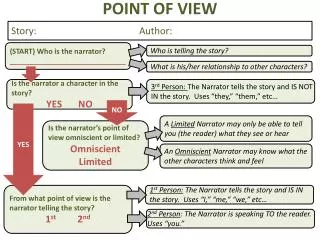
The point of view in storytelling shapes our experience as readers. It determines how we "see" and "hear" the narrative. An author can choose from various perspectives: first-person invites intimacy, while third-person limited allows insight into one character’s thoughts, third-person objective reports observations without feelings, and third-person omniscient shares multiple characters’ insights. The second-person perspective addresses the reader directly, adding a unique layer of engagement. Understanding these perspectives helps us appreciate how authors craft their narratives.

Point of View
E N D
Presentation Transcript
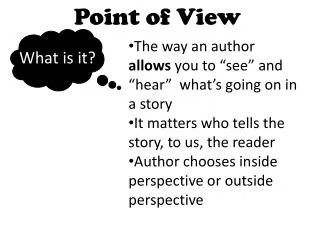
Point of View • The way an author allows you to “see” and “hear” what’s going on in a story • It matters who tells the story, to us, the reader • Author chooses inside perspective or outside perspective What is it?
Point of View I’m gonna tell you MY story! • First-person • Character narrates the story Key Words I MeMy WeOur
Point of View I’m gonna tell you HISstory! • 3rd-person limited • Narrator is NOT in the story • “Eye in the sky” that follows ONE character Key Words He She It They 3
Point of View Here’s what I observed… • 3rd-person objective • Narrator is NOT in the story • “Eye in the sky” that reports what they observe but leaves out any feelings or thoughts. 3 Key Words He She It They
Point of View I’m gonna tell you THEIRstory! • 3rd-person omniscient • Narrator is NOT in the story • “Eye in the sky” that follows MULTIPLE characters Key Words He She It They 3
Point of View HEY! I’m talking to YOU! • 2nd person • Narrator switches and talks directly to the reader • Usually used for writing directions or giving advice 2 Key Word YOU
Point of View Think about it.. I control what you know! • The author manipulates the information a reader knows through the use of point of view. Why?