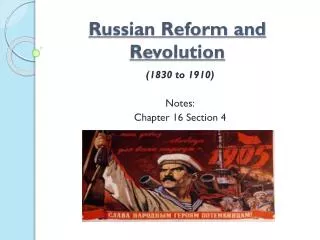
Russian Reform and Revolution
90 likes | 222 Vues
By the mid-1800s, Russia led Europe in land and population but faced significant challenges. It struggled with industrialization, remained landlocked, and housed diverse ethnic groups. Czar Alexander II initiated key reforms, including the Emancipation Edict of 1861, which freed serfs and laid the groundwork for new local governance. However, his successors, Alexander III and Nicholas II, reverted to conservative policies, leading to political unrest. Major events like the Russo-Japanese War and Bloody Sunday (1905) revealed governmental weakness, culminating in the creation of the Duma, Russia's first parliament.


Russian Reform and Revolution
E N D
Presentation Transcript
Russian Reform and Revolution (1830 to 1910) Notes: Chapter 16 Section 4
I.) Background of Times • By mid-1800’s Russia has largest amount of land and population of all European nations • Problems: 1. lacked industry 2. landlocked (no port on Mediterranean Sea) 3. wide range of ethnic peoples - Belorussians (west) - Ukranians (south) - Great Russians (north/central) –Slavic background--
West begins to influence Russia 1. liberal ideas pressure Czar (name given to Russian leader) 2. ruled as an autocrat (one who holds absolute power) • Domestic Policy: 1. censor speech/press 2. Russification: program by Czar Nicholas I for non-Russians to adopt language, religion, & customs • Foreign Policy: 1. Pan-Slavism= unite all Slavic people under Russian leadership 2. Expand into Asia & toward Ottoman Empire
II.) Reforms under Czar Alexander II • In 1855 Alexander II becomes czar of Russia • Reforms: 1. Emancipation Edict: 1861 all serfs living in Russia are free Result: cheap source of labor for factories 2. 1864 law created a new system for local govt. Result:Zemstvos= councils at provincial & county levels 3. Reformed the courts, limited powers of secret police, gave press greater freedom, reorganized military
Radical groups 1. Nihilists= 1860’s group of middle class & intellectuals revolutionaries 2. Populists= 1870’s group of revolutionaries 3. People’s Will= radical group who carried out terrorism Outcome: - cause Czar Alexander II becomes conservative; - killed by terrorist bomb in 1881
III.) Czar Alexander III & Czar Nicholas II • In 1881 Alexander III becomes Czar • Halts all reforms in Russia: - strict censorship - secret police - oppressed nationalist groups - Pogroms= organized violence against Jews • In 1894 Nicholas II becomes Czar - Remains autocratic - Higher taxes & foreign investments lead to rapid industrialization Example: Trans-Siberian Railway= worlds largest continuing railroad (1891-1904)
IV.) Political Unrest Leads to Revolution • Growth of industry creates working class w/ low standard of living and little or no political power Outcome: - creates large gap between rich and poor - Russian Marxists lead by Karl Marx believe industrial workers can overthrow the czar * Bolsheviks and Mensheviks * Bolsheviks lead by Lenin (Vladimir Ilyich Ulyanov)
Russo-Japanese War (1904-1905) • 1. Japan vs. Russia for control of • Manchuria & Korea • 2. Russia defeated = proves govt. • was weak and corrupt • Bloody Sunday (Jan. 22, 1905) 1. 200,000 protestors march w/ petition of rights for workers for Czar Nicholas II to sign 2. Military fires upon crowd killing between 500-1,000 3. Provokes waves of strikes & violence around the country……… “Revolution of 1905” • Oct. 1905 the Duma– Russia’s first parliament is created as a results of the revolts • Czar is NOT overthrown……………….......…