Download
1 / 21
260 likes | 409 Vues
This document outlines the technical advancements and ongoing projects in the LISA and VIRGO initiatives aimed at enhancing gravitational wave detection capabilities. Key topics include the linear alignment techniques for the VIRGO interferometer, improvements in mirror suspension systems, and the adaptation of high-performance electronics for signal processing. Notable methodologies include phase modulation, differential wavefront sensing, and innovative noise reduction strategies. The text also discusses manpower estimates and future developments in alignment systems that are crucial for the success of these next-generation projects.

E N D
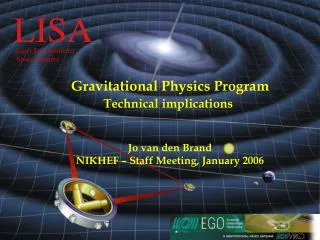
LISA Laser Interferometer Space Antenna Gravitational Physics Program Technical implications Jo van den Brand NIKHEF – Staff Meeting, January 2006 http://www.esa.int/science/lisa October 3, 2005
VIRGO & Lisa – Technical activities • Linear alignment of Virgo • Keep mirrors and input beam aligned • Monolithic suspension of Virgo mirrors • Reduce thermal noise • Recycling mirror for Virgo+ • Improve mirror suspension • Lisa electronics • Drag-free control readout
W N EOM Linear alignment of VIRGO interferometer • Phase modulation of input beam • Demodulation of photodiode signals at different output beams • => longitudinal error signals • Quadrant diodes in output beams • => Alignment information • (differential wavefront sensing) • Anderson-Giordano technique • 2 quadrant diodes after arm cavities
Can have 1 normal diode and 2 quadrant diodesat each output port Detection
Present Virgo noise budget Control noise
Present situation • Frascati group is leaving Virgo • Since 01/2006 • Frascati’s responsibilities • Original design of alignment system • Strategy, optics, prototype experiments, … • Design & realization of electronics • Problem • Continue support for alignment electronics • Make new modules / spare modules • Continue development for new requirements
Developments • Present developments • More modules needed • Installation of 9th quadrant diode (maybe 10th) • Spares needed • New Annecy local oscillator boards, compatible with alignment • Phase shifters for standard photodiodes • Possible developments • Substitute Si diodes with InGaAs diodes • Better quantum efficiency • Lower bias voltage • => higher power capability • lower noise • Reduction of electronics noise • Better preamplifier: 5 pA/rtHz -> 1.6 pA/rtHz (?) • DC signals: pre-amplification / pre-shaping • Fast quadrant centering system • (Napoli is working on that) • LA noise limits sensibility (especially at low frequencies)
phase shifter demodulator QD electronics Quadrant diode box Manpower estimate ~ 3FTE from electronics group
Virgo – local control of mirrors Local control of mirrors Present accuracy about 1 micron Feedback systems induce noise Possible application for RASNIC
VIRGO Optical Scheme Input Mode Cleaner (144 m) 3 km long Fabry-Perot Cavities Laser 20 W Power Recycling Output Mode Cleaner (4 cm)
Mirror suspension • High quality fused silica mirrors • 35 cm diameter, 10 cm thickness, 21 kg mass • Substrate losses ~1 ppm • Coating losses <5 ppm • Surface deformation ~l/100
Superattenuators Possible contributions: • Virgo+ will use monolythic suspension • Input-mode cleaner suspension
Monolithic suspension • Fused silica fibers • Bonded to mirror • Reduce thermal noise • Needed for Virgo+ • Realized by GEO600 Weld Silicate (Hydroxy- Catalysis) Bonding
Input beam Transm. beam Refl. beam Input mode cleaner • Mode cleaner cavity: filterslaser noise, select TEM00 mode
LISA - drag free control • SRON • Test equipment for position sensor read-out electronics in on-ground tests of the satellite system • Simulation software modules of the position sensors, used in system simulations • TNO-TPD • Test equipment of the Laser Optical Bench • Decaging Mechanism (TBC) • Bradford Engineering • Cold Gas propulsion (TBC)
LISA key technology • Test-mass position sensing: Capacitive sensing. • Drag-Free control. • FEEP micro-Newton thrusters. NIKHEF and SRON develop ASICS for electronic readout of all LISA signals Low noise, high resolution ADCs NIKHEF 2 – 3 ASIC designers + 2 FTE support
Summary • Linear alignment of Virgo • 3 FTE electronics • Monolithic suspension of Virgo mirrors • 2 FTE EA • Recycling mirror for Virgo+ • 2 FTE EA • Lisa electronics • 2 – 3 ASICS designers • 2 FTE support
Maximized power Optimized mirror centering (0.2 mm) Optimized alignment noise budget
Low-pass filter AC: Gain 200 diff. sig. QD box Shot noise VME non-diff.sig. DC: Gain 1 Preamp. noise ADC noise Non-optimal treatment of DC signals dominated by ADC noise (but were not foreseen as error signals) Scheme of LA electronics