Download
1 / 12
120 likes | 244 Vues
Explore different types of neurons - sensory, motor, and interneurons, as well as the transmission of nerve impulses. Learn about nerve impulses, resting and action potentials, neurotransmitters, and the effects of drugs on the nervous system. Discover the roles of sensory receptors - mechanoreceptors, thermoreceptors, pain receptors, chemoreceptors, and photoreceptors.

E N D
PP 1016-1024 Nervous System Part II NERVOUS SYSTEM II
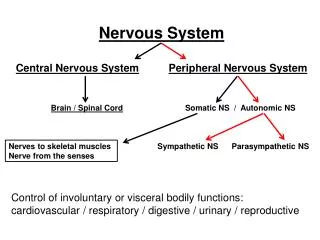
TYPES OF NEURONS • sensory – sense organs/receptors to CNS. • motor – carry information from CNS to muscles and glands • interneurons – connect sensory and motor and carry impulses between them.
NERVE IMPULSES • An electrical impulse • Resting potential: inactive due to “negatively” charged inside as compared to impulse • Action potential: helps the transmission of an electrical impulse by making inside more “positive”
NERVE IMPULSES • When the impulse reaches terminal neurotransmitters are released into synaptic cleft
Effect of drugs on the nervous system • Drug: chemical compound that affects the body
Drugs may…. • Prevent re-uptake of neurotransmitters • Over stimulation of nervous system • Mimicking neurotransmitters
Sensory Receptors • Neuron that detects stimuli.
Mechanoreceptors • Detect pressure and movement • Sense: Hearing and touch
Thermoreceptor • Detect temperature
Pain receptor • Detect tissue damage
Chemoreceptors • Respond to chemicals • Sense: Smell and taste
Photoreceptor • Respond to variation in light • Sense: sight