Analysis of Composite Bar Contraction Under Load and Temperature Effects
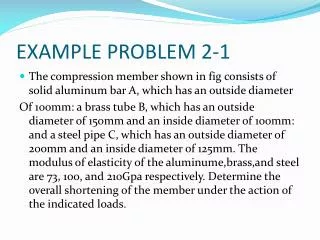
This problem involves the calculation of the overall shortening of a composite member composed of solid aluminum, brass, and steel subjected to specific axial loads. The aluminum bar has a diameter of 100 mm, the brass tube has a 150 mm outer and 100 mm inner diameter, while the steel pipe features diameters of 200 mm outer and 125 mm inner. Given the respective Young's moduli of 73 GPa (aluminum), 100 GPa (brass), and 210 GPa (steel), we need to determine the member's total deformation under applied loads of 650 kN, 850 kN, and 1500 kN. Additionally, a steel rod's length change due to tensile load and temperature variation is analyzed.

Analysis of Composite Bar Contraction Under Load and Temperature Effects
E N D
Presentation Transcript
EXAMPLE PROBLEM 2-1 • The compression member shown in fig consists of solid aluminum bar A, which has an outside diameter Of 100mm: a brass tube B, which has an outside diameter of 150mm and an inside diameter of 100mm: and a steel pipe C, which has an outside diameter of 200mm and an inside diameter of 125mm. The modulus of elasticity of the aluminume,brass,and steel are 73, 100, and 210Gpa respectively. Determine the overall shortening of the member under the action of the indicated loads.
P1=650KN A 1m P2=850KN B 1.25m P3=1500KN 0.75m C
EXAMPLE PROBLEM 2-2 • A ½-in-diameter steel [E=30000 ksi, α=6.5(10-6)/0f] rod has an initial length of 6 ft. determine the change in length of the rod after a tensile load of 500 lb is applied to the rod and the temperature of the rod decreases 500f.