SlideServe
Menu
Préférences
© SlideServe · v2026

Understanding Acceleration: Definitions and Examples in Physics

kirsi avatar
27 diapositives · 410 Views · Oct 03, 2014
Understanding Acceleration: Definitions and Examples in Physics - slide 1
01 / 27Understanding Acceleration: Definitions and Examples in Physics
1 / 17

Télécharger la présentation

Understanding Acceleration: Definitions and Examples in Physics
Une image / un lien ci-dessous est fourni (tel quel) pour télécharger la présentation

Politique de téléchargement : le contenu du site vous est fourni TEL QUEL pour votre information et votre usage personnel ; il ne peut être vendu, concédé sous licence ni partagé sur d’autres sites sans l’accord de son auteur.Le contenu vous est fourni TEL QUEL, pour votre information et votre usage personnel uniquement. Téléchargez la présentation en cliquant sur ce lien. Lors du téléchargement, si vous ne parvenez pas à télécharger une présentation, l’éditeur a peut-être supprimé le fichier de son serveur.Pendant le téléchargement, si vous ne parvenez pas à obtenir une présentation, le fichier a peut-être été supprimé par l’éditeur.

F I N

Plus de contenu associé

Transcription de la présentation
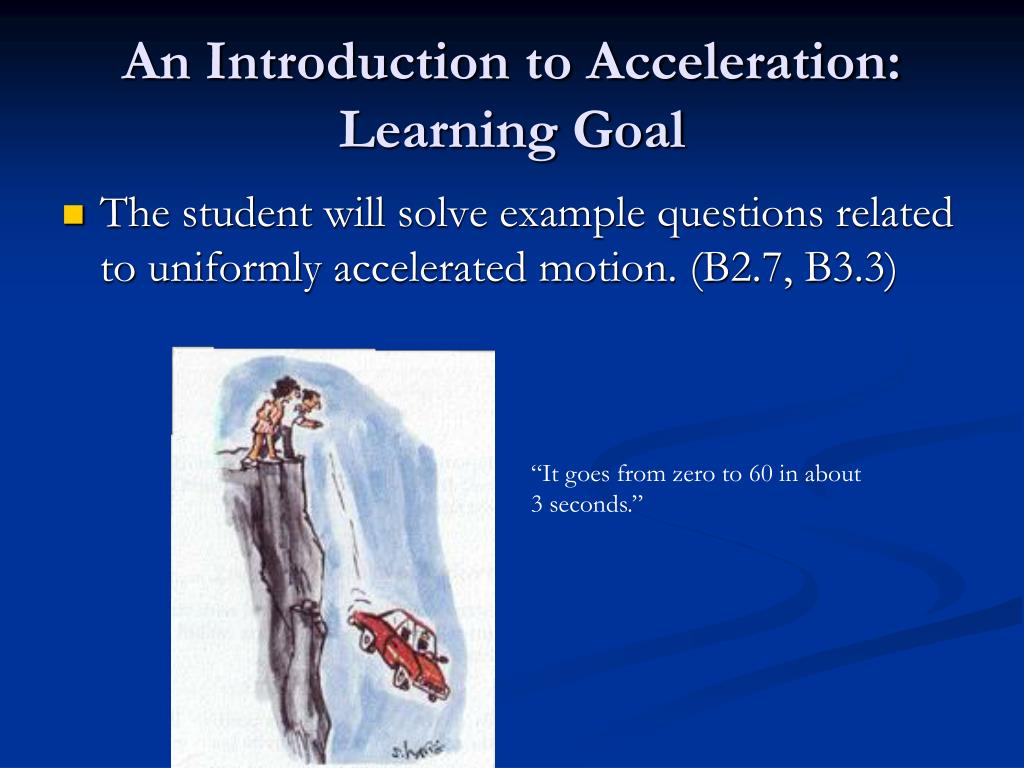
  1. An Introduction to Acceleration: Learning Goal • The student will solve example questions related to uniformly accelerated motion. (B2.7, B3.3) “It goes from zero to 60 in about 3 seconds.”

  2. An Introduction to Acceleration SPH4C

  3. Acceleration Acceleration is defined as the change in the velocity of an object per interval of time, or:

  4. Acceleration Acceleration is defined as the change in the velocity of an object per interval of time, or:

  5. Acceleration Acceleration is defined as the change in the velocity of an object per interval of time, or:

  6. Acceleration Acceleration is defined as the change in the velocity of an object per interval of time, or: v2 = final velocity and v1 = initial velocity

  7. Acceleration Acceleration will have units of m/s/s or m/s2. (Notice also that acceleration is a vector.)

  8. Example 1 Jake increases his velocity from 13 m/s [E] to 25 m/s [E] in 5.0 s. What is his acceleration?

  9. Example 1 Jake increases his velocity from 13 m/s [E] to 25 m/s [E] in 5.0 s. What is his acceleration?

  10. Example 1 Jake increases his velocity from 13 m/s [E] to 25 m/s [E] in 5.0 s. What is his acceleration?

  11. Example 1 Jake increases his velocity from 13 m/s [E] to 25 m/s [E] in 5.0 s. What is his acceleration?

  12. Example 1 Jake increases his velocity from 13 m/s [E] to 25 m/s [E] in 5.0 s. What is his acceleration? His acceleration is 2.4 m/s2 [E].

  13. Example 2 Richard reduces his velocity from 15 m/s [forward] to 12 m/s [forward] in 4.0 s. What is his acceleration?

  14. Example 2 Richard reduces his velocity from 15 m/s [forward] to 12 m/s [forward] in 4.0 s. What is his acceleration?

  15. Example 2 Richard reduces his velocity from 15 m/s [forward] to 12 m/s [forward] in 4.0 s. What is his acceleration?

  16. Example 2 Richard reduces his velocity from 15 m/s [forward] to 12 m/s [forward] in 4.0 s. What is his acceleration? His acceleration is 0.75 m/s2 [backward].

  17. Rearranging the Equation The equation that represents the definition of acceleration may be rearranged to solve for any of the other variables, e.g. (solving for v2)

  18. Rearranging the Equation The equation that represents the definition of acceleration may be rearranged to solve for any of the other variables, e.g.

  19. Rearranging the Equation The equation that represents the definition of acceleration may be rearranged to solve for any of the other variables, e.g.

  20. Rearranging the Equation The equation that represents the definition of acceleration may be rearranged to solve for any of the other variables, e.g.

  21. Rearranging the Equation The equation that represents the definition of acceleration may be rearranged to solve for any of the other variables, e.g.

  22. Rearranging the Equation The equation that represents the definition of acceleration may be rearranged to solve for any of the other variables, e.g.

  23. Example 3 A ball is travelling at 12 m/s [up] and being accelerated at 9.8 m/s2 [down]. What is its velocity after 2.0 s?

  24. Example 3 A ball is travelling at 12 m/s [up] and being accelerated at 9.8 m/s2 [down]. What is its velocity after 2.0 s?

  25. Example 3 A ball is travelling at 12 m/s [up] and being accelerated at 9.8 m/s2 [down]. What is its velocity after 2.0 s?

  26. Example 3 A ball is travelling at 12 m/s [up] and being accelerated at 9.8 m/s2 [down]. What is its velocity after 2.0 s? Its velocity is 7.6 m/s [down].

  27. More Practice Playing with the Ticker Timers and Acceleration Graphing Acceleration