The Assessment Continuum
In this engaging lecture, Gerd Kortemeyer from Michigan State University explores the effective integration of technology into education. He emphasizes that technology should support educational goals, rather than serve as a mere gimmick. The discussion covers formative and summative assessment strategies, including Just-In-Time Teaching and the use of clickers for real-time feedback. Kortemeyer highlights the importance of continuous learner assessment, tailored instruction, and collaborative learning, demonstrating how technology can significantly enhance student interaction and learning outcomes.

The Assessment Continuum
E N D
Presentation Transcript
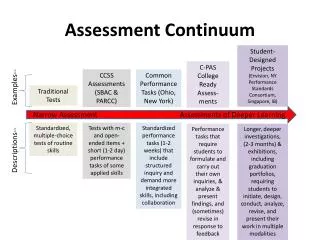
The Assessment Continuum Before, in, and after lecture Gerd Kortemeyer Michigan State University Jan 25th, 2012
What makes a good use of technology in education? Must be integrated into the educational experience! • supporting the goals - not technology for technology sake • not scattered "technology highlights" - consistently applied - students know what to expect and what is expected • moving into the background - not wizz-bang or gimmicky • increasing effective time on task - make the students interact with the materials - do not waste student time • Giving effective and timely feedback to learners and instructors: assessment
Assessment • Assessment: Feedback to learners and instructors • Formative assessment: • Students can keep track of their own learning • Students do not fall behind • Instructors keep track of their students’ learning • can adapt the teaching to the learning • Summative assessment: exams • Technology allows for frequent exams
Assessment • Pre-Class Questions • Students being prepared for lecture • Just-In-Time Teaching • In-Class Questions • Clickers • Post-Class Questions • Homework • Online Discussions, Helprooms • Exams • Does this even work? • How is this realistically possible? • That’s where course and learning content management come in! Lecture ?
Pre-Class Questions Students being prepared for lecture Just-In-Time Teaching
Pre-Class Questions • Easy questions embedded into content • Due before lecture
Pre-Class Questions • Make sure students read materials • Questions can be answered just based on the readings • Students come prepared
Just-In-Time • Adapt lecture to student difficulties When I looked at your homework this morning, I saw that all of you have understood quantum field theory, but many of you still have problems with long division. So this morning, we will …
Just-In-Time Discussions Difficult problems
In-Class Questions Clickers
Clickers That’s clear – no, wait … Doesn’t he get that we don’t get it? Yawn! Looks like everybody but me understands this! I wonder what’s for lunch Sadly, too often: Anonymous crowd in our lecture hall We don’t know what’s going on in their heads
Clickers • RF devices • One per student • Students can answer questions during lecture
Clicker Lecture progress depends on voting outcome • Explain again • Go on • Let students discussand vote again
Clicker Peer-Instruction • Students can sometimes explain concepts better than us to their peers • We have forgotten what we initially struggled with • Students learn while explaining
Clicker • Students register in LON-CAPA
Clicker • Give credit for correct and for incorrect answers
Clicker • Embedded in course, alongside slides
Currently under Development • Currently: uploading of session data • Work-in-progress: running session out of LON-CAPA • Questionsfrom sharedcontentlibrary(more later) • Item statistics
Post-Class Questions Homework Helprooms Exams
Homework Moresophisticatedhighlyrandomizingproblems
Homework • …special emphasis on math • including support of • LaTeX • Maxima • R
Homework • … chemistry …
Homework • … physical units …
Online Discussions Discussions Encouraged, since all students have different versions.Again: Peer-Instruction.
Helprooms • StaffedwithLearningAssistantsin theevenings • Collaborative learning space, peer instruction
Exams • Problems can also be rendered for bubble sheets • Each student has a different exam
Before we go on … … does this even work?
Learning Success • Intro Physics for Scientists and Engineers • Grades in years before and after online homework
Learning Success Mostly helps students who are on the brink of failing the course. Fail
Sharing of Resources • Creating online resources is a lot of work • Doing so for use in just one course is a waste of time and effort • Many resources could be used among a number of courses and across institutions
LON-CAPA Architecture WWW Web InstructorComputer Interserver Campus A Campus B Campus C WWW Inter-InstitutionalNetwork of Servers Connecting Universities and Schools Student Computer
Course Management Course Management ResourceAssembly ResourceAssembly SharedCross-InstitutionalResourceLibrary LON-CAPA Architecture Campus A Campus B
The LON-CAPA Community Shared content repository with almost 450,000 resources Almost 200,000 online homework problems
Thank You • Gerd Kortemeyer • Currently on sabbatical:Pritchard Group (RELATE), MIT Physics • kortemey@msu.edu