
SlideServe
Menu
Préférences
© SlideServe · v2026

Exceptions

knox-howard avatar
15 diapositives · 305 Views · Nov 13, 2014

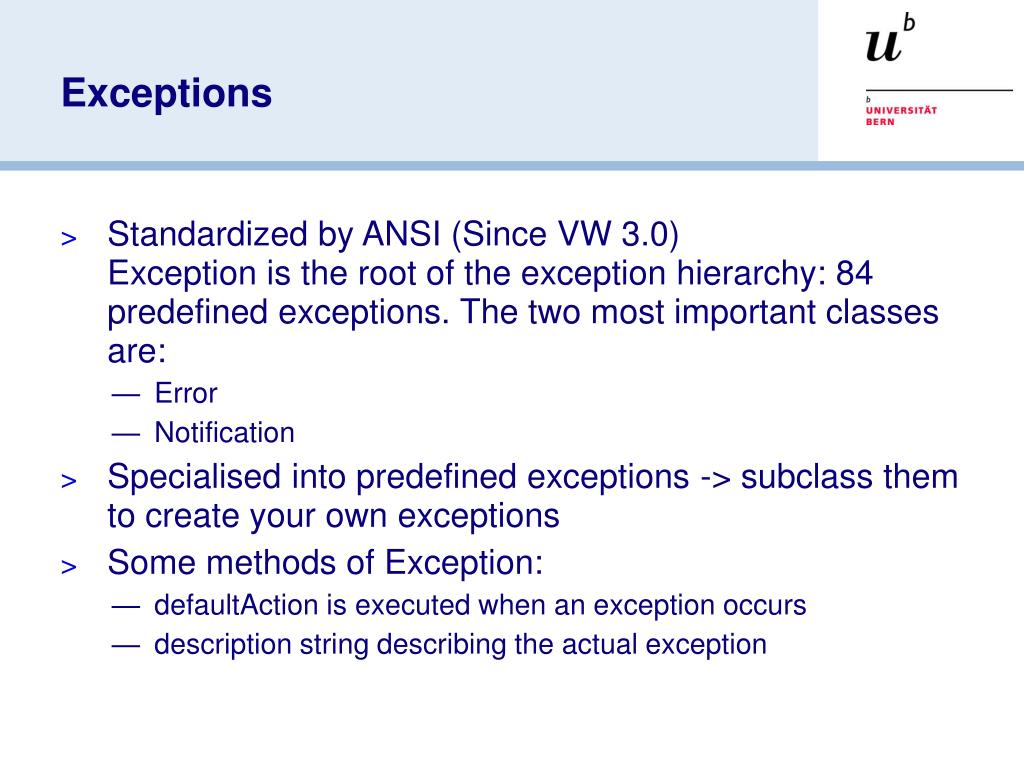
Exceptions. Standardized by ANSI (Since VW 3.0) Exception is the root of the exception hierarchy: 84 predefined exceptions. The two most important classes are: Error Notification Specialised into predefined exceptions -> subclass them to create your own exceptions Some methods of Exception:
Exceptions - slide 1
01 / 15Exceptions
1 / 17

Télécharger la présentation

Exceptions
Une image / un lien ci-dessous est fourni (tel quel) pour télécharger la présentation

Politique de téléchargement : le contenu du site vous est fourni TEL QUEL pour votre information et votre usage personnel ; il ne peut être vendu, concédé sous licence ni partagé sur d’autres sites sans l’accord de son auteur.Le contenu vous est fourni TEL QUEL, pour votre information et votre usage personnel uniquement. Téléchargez la présentation en cliquant sur ce lien. Lors du téléchargement, si vous ne parvenez pas à télécharger une présentation, l’éditeur a peut-être supprimé le fichier de son serveur.Pendant le téléchargement, si vous ne parvenez pas à obtenir une présentation, le fichier a peut-être été supprimé par l’éditeur.

F I N

Plus de contenu associé

Transcription de la présentation
  1. Exceptions • Standardized by ANSI (Since VW 3.0)Exception is the root of the exception hierarchy: 84 predefined exceptions. The two most important classes are: • Error • Notification • Specialised into predefined exceptions -> subclass them to create your own exceptions • Some methods of Exception: • defaultAction is executed when an exception occurs • description string describing the actual exception

  2. Catching an Exception • |x y| x := 7. • y := 0. [x/y] on: ZeroDivide do: [:exception| Transcript show: exception description, cr. 0....]

  3. Signaling an Exception • Error signal • Warning signal: ‘description of the exception’

  4. Exception • an Exception Handler is defined using on:do: and is composed of • an exception class (ZeroDivide) and • a handler block [:theException| Transcript show: ‘ division by zero’] • An Exception Handler completes by returning the value of the handler block in place of the value of the protected block (here [x/y]). • We can exit the current method by putting an explicit return inside the handler block

  5. The Main Exceptions of VW

  6. Exception Sets • Exception Sets [do some work] on: ZeroDivide, Warning do: [ :ex| what you want]Or |exceptionSets| exceptionSets := ExceptionSet with: ZeroDivide • with: Warning. [do some work] on: exceptionSets do: [ :ex| what you want]

  7. Exception Environment • Each process has its own exception environment: an ordered list of active handlers. • Process starts -> list empty • [aaaa] on: Error do: [bbb] -> Error,bbb added to the beginning of the list • When an exception is signaled, the system sends a message to the first handler of the exception handler. • If the handler cannot handle the exception, the next one is asked • If no handler can handle the exception then the default action is performed

  8. Resumable and Non-Resumable (i) • A handler block completes by executing the last statement of the block. The value of the last statement is then the value returned by the handler block. • Where this value should be returned depends: • Nonresumable (Error) • Sq: ([Error signal. ‘Value from protected block’] on: Error do: [:ex|ex return: ‘Value from handler’]) • > ‘Value from handler’

  9. Resumable and Non-Resumable (ii) • Resumable (Warning, Notification) • In this case Notification signal raises an exception, then the context is restored and the value returned normally • VW: ([Notification raiseSignal. ‘Value from protected block’] on: Notification do: [:ex|ex resume: ‘Value from handler’]) • Sq: ([Notification signal. 'Value from protected block'] on: Notification do: [:ex|ex resume: 'Value from handler']) • > ‘Value from protected Block’.

  10. Resume:/Return: • Transcript show: ([Notification raiseSignal. 'Value from protected block'] on: Notification do: [:ex| Transcript show: 'Entering handler '. 'Value from handler'. '5']) • -> Entering handler 5

  11. Resume:/Return: • Transcript show: ([Notification raiseSignal. 'Value from protected block'] on: Notification do: [:ex| Transcript show: 'Entering handler '. ex resume: 'Value from handler'. '5']) • > Entering handler Value from protected block • Transcript show: ([Notification raiseSignal. 'Value from protected'] on: Notification do: [:ex| Transcript show: 'Entering handler '. ex return: 'Value from handler'. '5']) • -> Entering handler Value from handler

  12. Exiting Handlers Explicitly • exit or exit: (VW specific) Resumes on a resumable and returns on a nonresumable exception • resume or resume: Attempts to continue processing the protected block, immeditely following the message that triggered the exception. • return or return: ends processing the protected block that triggered the exception • retry re-evaluates the protected block • retryUsing:evaluates a new block in place of the protected block

  13. Exiting Handlers Explicitly (ii) • resignalAs: resignal the exception as another onpass exit the current handler and pass to the next outer handler, control does not return to the passer • outer as with pass, except will regain control if the outer handler resumes • exit:, resume: and return: return their argument as the return value, instead of the value of the final statement of the handler block

  14. Examples • Look in Exception class examples categories -2.0 to: 2.0 do: [ :i | [ 10.0 / i. Transcript cr; show: i printString ] on: Number divisionByZeroSignal do: [:ex | Transcript cr; show: 'divideByZero abort'. ex return ] ] • -2.0 -1.0 divideByZero abort1.02.0

  15. Examples • retry recreates the exception environment of active handlers [ x /y] on: ZeroDivide do: [:exception| y := 0.00001. exception retry]