Proving Triangle Congruence Using the Third Angles Theorem
This text details the application of the Third Angles Theorem and the Triangle Sum Theorem to prove triangle congruence. By establishing relationships among angles and using the Reflexive Property of Congruence, the proof demonstrates that if two angles are congruent, their corresponding sides are also congruent. This is essential for understanding triangle properties and solving geometric problems, providing a systematic approach to triangle congruence.

Proving Triangle Congruence Using the Third Angles Theorem
E N D
Presentation Transcript
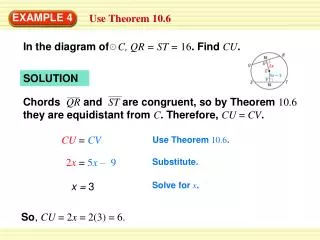
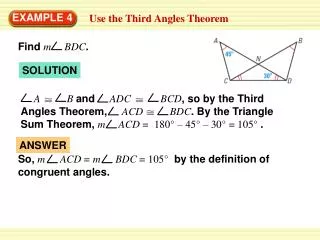
FindmBDC. SOLUTION AB and ADCBCD, so by the Third Angles Theorem, ACDBDC. By the Triangle Sum Theorem, m ACD = 180°– 45° – 30°= 105° . So, mACD =mBDC = 105° by the definition of congruent angles. ANSWER EXAMPLE 4 Use the Third Angles Theorem
Write a proof. GIVEN AD CB,DC AB CADACB ACDCAB, ACDCAB PROVE Use the Reflexive Property to show that AC AC. Use the Third Angles Theorem to show that BD EXAMPLE 5 Prove that triangles are congruent Plan for Proof
STATEMENTS REASONS ,DC BA AD CB Given Reflexive Property of Congruence AC AC. ACDCAB, Given CADACB BD Third Angles Theorem ACDCAB Definition of EXAMPLE 5 Prove that triangles are congruent Plan in Action
In the diagram, what is m DCN. CDN NSR, DNC SNRthen the third angles are also congruent NRS DCN = 75° for Examples 4 and 5 GUIDED PRACTICE SOLUTION
By the definition of congruence, what additional information is needed to know that NDC NSR. Given : CN NR, CDN NSR, DCN NRS Proved : NDC NSR. for Examples 4 and 5 GUIDED PRACTICE SOLUTION (Proved from above sum)
STATEMENT REASON CDN NSR DCN NRS ThereforeDC RS, DN SNas angles are congruent their sides are congruent. for Examples 4 and 5 GUIDED PRACTICE Given Given