Bridging the FIR Gap: A New Observatory to Enhance Astro-Science Resolution and Sensitivity
10 likes | 128 Vues
In the L2/L3 era, the FIR domain faces significant resolution and sensitivity gaps between ALMA and JWST/E-ELT. Our proposed observatory aims to tackle these challenges by mapping key tracers, including dust continuum peaks, molecular species like water and HD, and fine structure lines across various ISM phases. This initiative targets critical science cases in protoplanetary disks, star formation, the nearby universe, and the evolving connections between galaxies and central black holes. Join us in supporting this vital advancement in infrared astrophysics at www.firi.eu.


Bridging the FIR Gap: A New Observatory to Enhance Astro-Science Resolution and Sensitivity
E N D
Presentation Transcript
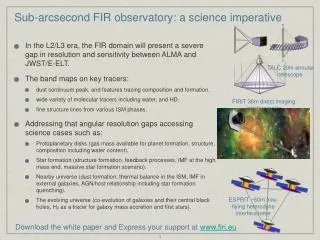
Sub-arcsecond FIR observatory: a science imperative • In the L2/L3 era, the FIR domain will present a severe gap in resolution and sensitivity between ALMA and JWST/E-ELT. • The band maps on key tracers: • dust continuum peak, and features tracing composition and formation. • wide variety of molecular tracers including water, and HD. • fine structure lines from various ISM phases. • Addressing that angular resolution gaps accessing science cases such as: • Protoplanetary disks (gas mass available for planet formation, structure, composition including water content). • Star formation (structure formation, feedback processes, IMF at the high mass end, massive star formation scenario). • Nearby universe (dust formation, thermal balance in the ISM, IMF in external galaxies, AGN/host relationship including star formation quenching). • The evolving universe (co-evolution of galaxies and their central black holes, H2 as a tracer for galaxy mass accretion and first stars). TALC 20m annular telescope FIRIT 36m direct imaging interferometer ESPRIT ~50m free-flying heterodyne interferometer Download the white paper and Express your support at www.firi.eu