Download
1 / 8
80 likes | 199 Vues
This educational overview clarifies the concept of significant figures, essential for precision in scientific measurements. Learn how significant digits indicate a tool's precision and distinguish between precision and accuracy. Additionally, gain insights into controlled experiments, including variables and their impact on data, and explore definitions of homogeneous and heterogeneous mixtures, elements, and compounds. Finally, we provide practical materials for conducting experiments related to reaction rates and environmental effects.

E N D
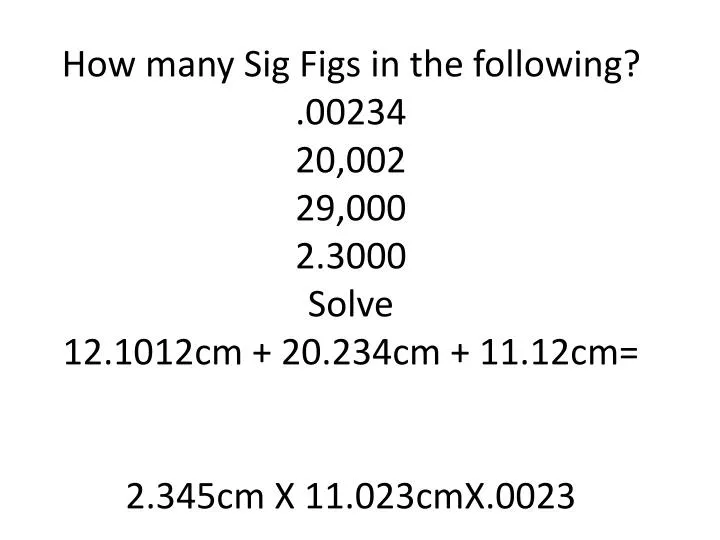
Try These:How many Sig Figs in the following?.0023420,00229,0002.3000Solve12.1012cm + 20.234cm + 11.12cm=2.345cm X 11.023cmX.0023
Oh Wow…We need a review • Homogeneous Mixture-something consistent throughout Ex: Salt water • Heterogeneous-Mixed composition throughout Ex: Alphabet soup, Sample of Dirt • Element- Basic Building Block (See Periodic Table) Ex: N,I,O • Compound-composed of elements • Ex: CO2 • Pure substance can’t be separated with out a change of composition (O2, NaCl (salt), H2O) can be elements or compounds
How does significant digits relate to tools in science? • Significant Digits show how precise a tool is • Precision is How close measurements are to each other • This is different than accuracy which is how close you are to the correct answer
Explain what a precise dart player would look like. How would this compare to an accurate player?
What does it mean Control a procedure? • In a controlled experiment everything is the same except for the manipulated variable
How does this relate to an experimental control? • An experimental control determines if the environment has any affect on the data
You will design an experiment to determine the affect of temperature on Reaction Rate • Available Materials • Beakers, Ice, Water, 3 polident tablets, graduated cylinders