Download
1 / 17
170 likes | 298 Vues
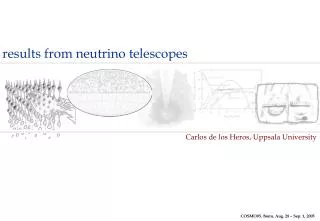
This research presents results from JET on measuring the thermal and non-thermal neutron yield using Neutron Emission Spectroscopy, with a focus on deuterium discharges and neutral beam injection heating. Utilizing the innovative TOFOR neutron spectrometer, we analyze neutron spectra to highlight key components such as broad contributions from NBI deuterons and low-energy tails due to scattering. We also discuss the implementation of the TRANSP simulation code for accurate spectral modeling and the implications for future ITER configurations, advancing our understanding of fusion plasma dynamics.

E N D
JET results on the determination of thermal/non-thermal fusion yield from neutron emission spectroscopy Giuseppe Gorini on behalf of Uppsala University Istituto di Fisica del Plasma “Piero Caldirola”,CNR & Milano-Bicocca University, Milano, Italy EFDA JET Collaborators G.Gorini
Issue: Thermal and non-thermal neutron yield (Q value)used nowadays for physics analysis of fusion plasmas (e.g. JET). Not measured.Qnth/Qth desirable measurement on ITER.Can Neutron Emission Spectroscopy determinethe thermal and non-thermal neutron yield and their ratio?Here: JET results from selected D dischargeswith NBI heating. G.Gorini
TOFOR neutron spectromer TOFOR is a new 2.5 MeV Time-Of-Flight neutron spectrometer Optimized for high Rate operation (>200 kHz range) neutrons G.Gorini
TOFOR neutron spectra • Main features in the measured TOF spectrum: • Broad component (e.g. due to NBI deuterons) • Low energy tail due to neutron scattering • Higher energy neutrons: missing in the absence of RF heating #69242, D plasma, NB heating, single injector tof[ns] G.Gorini
TOFOR neutron spectra (linear scale) #69242, D plasma, NB heating, single injector G.Gorini
NBI in JET • Full model in TRANSP G.Gorini
TRANSP • Input experimental data • Simulation of: • Equilibrium • Trasport • Fast ion dynamics • Radiation emission etc (e.g. for diagnostic comparison) • NUBEAM G.Gorini
NUBEAM Motion of particles Neutral deposition Ionizzation Orbits Collisions and thermalization G.Gorini
Control Room • Control Room is a MonteCarlo code first developed in 1994. • The original system consisted on a C++ library and a few applications • whose purpose was the calculation of slowing-down ion distributions and the resulting neutron emission in thermonuclear plasmas. • Now it is possible to use the library from within the Python programming language. In fact, one could say the library was designed for being used as a Python module. This gives the user a number of advantages. On the • one hand, this allows one to test-drive the library through the interactive • Python interpreter and makes it easier to experiment with its features. On the other hand, this enables the user to write simple scripts. G.Gorini
Example of spectrum #69625 t = 58 s. G.Gorini
TOFOR data Pulse: 69652 PNBI = 13 MW Ip = 2.6 MA BT = 2.2 T T= 1.7 keV Chi2 = 0.98 G.Gorini
Pulse G.Gorini
MissingNeutrons G.Gorini
MissingNeutrons G.Gorini
Yth/Ynth G.Gorini
Role of sight line To what extent is the plasma volume seen by TOFOR representative of the TOTAL volume? Equation: y = a*(x-b) R2 = 0.98364 a = 1.216 ± 0.02391 b= 0.00269 ± 0.00369 G.Gorini
Conclusions TRANSP-based accurate simulation of neutron emission spectra with thermal and non-thermal components. Separation of thermal/non-thermal components possible. Accuracy depends on shape difference. On ITER shape will be very different => separation easier. G.Gorini