Understanding Symmetry in Polygons: Concepts and Vocabulary
In this lesson, we explore symmetry, focusing on rotational and reflective symmetry in polygons. A polygon is defined as a closed plane figure with three or more straight segments. We discuss key vocabulary, such as equiangular, equilateral, and regular polygons, as well as the concepts of reflectional and rotational symmetry. Students will learn how to identify and analyze the axes of symmetry in various polygons and calculate the central angle. Engage in activities that reinforce understanding of these essential geometric concepts.

Understanding Symmetry in Polygons: Concepts and Vocabulary
E N D
Presentation Transcript
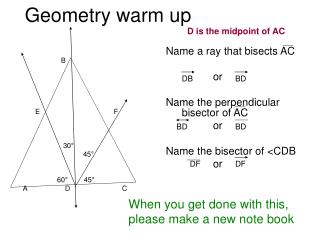
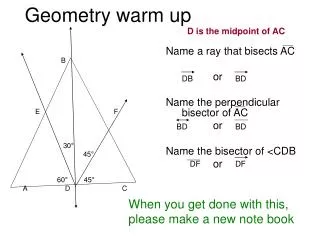
B E F 30° 45° 60° 45° A D C Name a ray that bisects AC or Name the perpendicular bisector of AC or Name the bisector of <CDB or BD DB BD DF BD DF Geometry warm up D is the midpoint of AC When you get done with this, please make a new note book
3.1 Symmetry in Polygons What is symmetry? There are two types we’re concerned with: Rotational and Reflective If a figure has ROTATIONAL symmetry, then you can rotate it about a center and it will match itself (don’t consider 0° or 360°) If a figure has REFLECTIONAL symmetry, it will reflect across an axis. What are polygons? A plane figure formed by 3 or more segments Has straight sides Sides intersect at vertices Only 2 sides intersect at any vertex It is a closed figure
Polygons are named by the number of sides they have: Names of polygons
Vocabulary • Equiangular – All angles are congruent • Equilateral – All sides are congruent • Regular (polygon) – All angles have the same measure AND all sides are congruent • Reflectional Symmetry – A figure can be cut in half and reflected across an axis of symmetry. • Rotational Symmetry – A figure has rotational symmetry iff it has at least one rotational image (not 0° or 360°) that coincides with the original image.
center Central angle EQUILATERAL triangle has 3 congruent sides ISOCELES triangle has at least 2 congruent sides SCALENE triangle has 0 congruent sides Center – in a regular polygon, this is the point equidistant from all vertices Central Angle – An angle whose vertex is the center of the polygon A little more vocab C
Activities • 3.1 Activities 1- 2 (hand out) • Turn it in with your homework
What you should have learned about Reflectional symmetry in regular polygons • When the number of sides is even, the axis of symmetry goes through 2 vertices • When the number of sides is odd, the axis of symmetry goes through one vertex and is a perpendicular bisector on the opposite side
What you should have learned about rotational symmetry • To find the measure of the central angle, theta, θ, of a regular polygon, divide 360° by the number of sides. 360/n = theta • To find the measure of theta in other shapes, ask: “when I rotate the shape, how many times does it land on top of the original?” • Something with 180° symmetry would have 2-fold rotational symmetry • Something with 90 degree rotational symmetry would be 4-fold
Homework • Practice 3.1 A, B & C worksheets