Download

1 / 5
50 likes | 170 Vues
This overview explores the complex factors driving immigration to the United States, including push factors such as religious and political persecution, famine, and overpopulation, alongside pull factors like job opportunities and freedom. It examines the origins of immigrants from Europe, Asia, and other regions, and highlights entry points like Ellis Island and Angel Island. The discourse on nativism reveals the competing views on cultural integration, particularly as seen through the restrictions enacted to curb immigration from certain ethnic groups, including the Chinese Exclusion Act and the Gentlemen's Agreement with Japan.

E N D
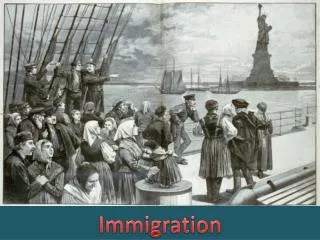
Immigration Review • Why did immigrants come to the U.S.? • Push Factors: Religious persecution, political persecution, famine, overpopulation • Pull Factors: Promise of a better life—jobs, freedom, opportunities • From where are most immigrants coming? • Europe: Before 1890—Northern and Western, 1890 and After—Southern, Eastern, and Central • Other Areas: Japan, China, Mexico, Caribbean Islands • Where are they entering the U.S.? • Ellis Island, New York (European) • Angel Island, California (Asian)
Immigration Restrictions • Native born Americans view the U.S. as a melting pot, which is a mixture of people of different cultures who blended together by abandoning their native languages and customs. • However, the new immigrants do not want to give up their cultural identities. • Because of these differing views, nativism (favoritism toward native-born Americans) and anti-immigrant groups and views developed leading to immigration restrictions.
Nativism • According to nativists, what group was the superior ethnic group? • Anglo-Saxon • WASP • White Anglo-Saxon Protestant • What countries were considered the “right” countries? • British, German, and Scandinavian • What countries were considered the “wrong” countries? • Slavic, Latin, and Asian • What religious groups were considered a threat to American society? • Roman Catholic and Jewish
Anti-Asian Sentiment • In the West, nativists were concerned that the Chinese would take jobs away from Americans, because they would work for less money, especially during the Panic of 1873. • Because of this, labor unions opposed immigration. • In 1882, Congress passed the Chinese Exclusion Act, which banned entry to all Chinese people except for students, teachers, merchants, tourists, and government officials for 10 years. • Japanese and other Asian groups were also discriminated against. • The Gentlemen’s Agreement was an agreement between the U.S. and Japan where the Japanese would limit the number of unskilled workers they would allow to leave for the U.S.