

SlideServe
Menu
Préférences
© SlideServe · v2026

Sleep & Dreaming

konane avatar
6 diapositives · 293 Views · Jul 18, 2014

Sleep & Dreaming. Why do we sleep? Restorative vs Adaptive Hypotheses. effects of sleep deprivation. TED talks: why we sleep. circadian rhythms. Suprachiasmatic nucleus . Circadian Rhythms and the…. Entrained by zeitgebers - SCN controls timing of sleep, not sleep itself.
Sleep & Dreaming - slide 1
01 / 6Sleep & Dreaming
1 / 17

Télécharger la présentation

Sleep & Dreaming
Une image / un lien ci-dessous est fourni (tel quel) pour télécharger la présentation

Politique de téléchargement : le contenu du site vous est fourni TEL QUEL pour votre information et votre usage personnel ; il ne peut être vendu, concédé sous licence ni partagé sur d’autres sites sans l’accord de son auteur.Le contenu vous est fourni TEL QUEL, pour votre information et votre usage personnel uniquement. Téléchargez la présentation en cliquant sur ce lien. Lors du téléchargement, si vous ne parvenez pas à télécharger une présentation, l’éditeur a peut-être supprimé le fichier de son serveur.Pendant le téléchargement, si vous ne parvenez pas à obtenir une présentation, le fichier a peut-être été supprimé par l’éditeur.

F I N

Plus de contenu associé

Transcription de la présentation
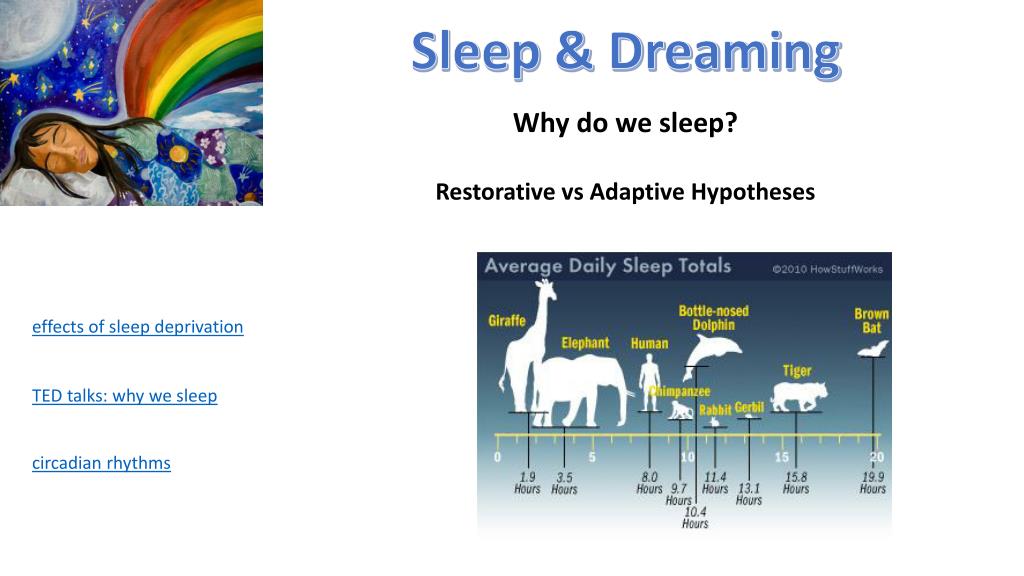
  1. Sleep & Dreaming Why do we sleep? Restorative vs Adaptive Hypotheses effects of sleep deprivation TED talks: why we sleep circadian rhythms

  2. Suprachiasmatic nucleus Circadian Rhythms and the… Entrained by zeitgebers - SCN controls timing of sleep, not sleep itself Retinal ganglion cells containing melanosporin respond to light Retinohypothalmic pathway Also regulated by on-off genes In the SCN SCN PinealGland melatonin

  3. Ultradian Rhythms beta Sleepwalking Bedwetting nightterrors sleepingwalking, nightterrors, bedwetting

  4. REM and Dreaming The purpose of REM sleep 1. perchance to dream 2. promote neural development during childhood 3. memory consolidation Neuronal replay in hippocampus is highest during non-REM sleep Non-REM sleep The purpose of slow wave sleep 1. rest and restoration of the body 2. cool down the brain 3. restore cognitive function, prefrontal cortex recovery During REM, memory traces are transferred to cortex This process may take 4-7 days to become permanent sleep & memory

  5. What puts us to sleep Key Concepts to know The NT adenosine inhibits arousal in the basal forebrain Adenosine warms cells in the preoptic area which helps to induce sleep Neurons in the ventrolateralpreoptic nucleus inhibit activitity of several structures in the pons tuberomammilary nucleus, PPT/LDT, LC, raphe nucleus Info from pons goes to the magnocellular n. (in the Medulla) to induce atonia

  6. What wakes us up Key Concepts to know Pathway 1: PPT/LDT stimulates structures in the pons These structures then send info to the cortex This pathway also shifts EEG to the arousal state Pathway 2: Pons structures (Locus coeruleus, raphe n., tuberomammilary n., ) and basal forebrain stimulate the cortex so it can better process input from the thalamus. The lateral hypothalamus stimulates the basal forebrain and pons structures. The LH does this by releasing the peptide orexin.