Gods and Goddesses
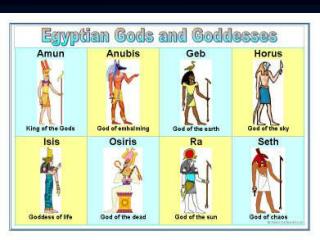
Gods and Goddesses. Polytheistic Many gods Each god linked to a specific aspect of the culture Ex. Sun, death Gods believed to have created and ruled the world. Ra. Sun god Most important god of the ancient Egyptians. Helped crops grow

Gods and Goddesses
E N D
Presentation Transcript
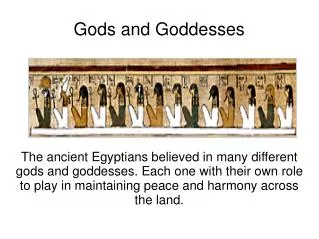
Gods and Goddesses • Polytheistic • Many gods • Each god linked to a specific aspect of the culture • Ex. Sun, death • Gods believed to have created and ruled the world
Ra Sun god • Most important god of the ancient Egyptians. • Helped crops grow • The ancient Egyptians believed that Ra was swallowed every night by the sky goddess Nut, and was reborn every morning.
Hapi • River god • Very important • Inundation • Annual flood of the Nile • Water and fertilesoil
Osiris • Chief god of underworld • Arms folded like dead • Holding staff and sekhem • The place where a dead person's soul would go to be judged. • The ancient Egyptians believed that a person's soul would have to pass a series of tests in the underworld before they were allowed to enter the afterlife where they would live forever.
Maat • Egyptian goddess of truth and balance • Feather
Anubis • Body of a man, head of a jackal • Helper of Osiris • Prepared the bodies of the dead for the afterlife • Key component of embalmment • Mummification
Ankh • Symbol of eternal life • Key of Life • Key of the Nile • Often carried by gods and goddesses Isis giving Nefertari eternal life
Akhenaten • Pharaoh from New Kingdom • Changed religion of Egypt • Previously Polytheistic • Many gods - Head God: Amun • Rel. Capitol – Thebes • Gov. Capitol - Memphis • Now Monotheistic • Aten – sole god • New Capitol - Akhenaten • Angered preists and commoners
Death of Akhenaten • Exact succession unknown. • Nefertiti - wife (Tut’s half mother) or Smenkhkare (half brother) • 1332 B.C. 9 year old Tutankhamen took throne • Probably Akhenaten’s son • Son of Kiya (lesser wife) • Problem: Religious turmoil
Pharaoh Tutankhamen • Raised Tutankhaten • Married half-sister • First act - rid Egypt of his father’s religion • Changed name to Tutankamen • Reestablished old capitols • Mystery surrounding Death • http://video.nationalgeographic.com/video/player/places/countries-places/egypt/king-tuts-tomb.html
Nemes • A piece of cloth pulled tight across the forehead and tied at the back, with two flaps hanging on the sides. • Kings shaved their heads but had a prominent beard.
Headgear • Cobra and vulture heads were worn on the forehead.