Download
1 / 21
210 likes | 315 Vues
This document details the analysis of user requirements for land cover data essential for climate modeling. It highlights three major applications of land cover datasets: as proxies for land surface parameters, to analyze human impacts on land use, and for validating climate model outcomes. Users predominantly seek long-term consistency, dynamic components, and detailed classifications (natural versus anthropogenic) for diverse applications. This study underscores the importance of satellite remote sensing in mapping land cover and provides specifications aimed at improving data utility and transparency, addressing user needs in climate science contexts.

E N D
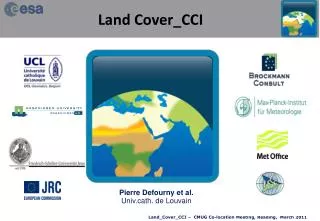
Land Cover_CCI Pierre Defourny et al. Univ.cath. de Louvain
Land Cover: 3 main uses in climate com. Users requirements analysis considered the diversity of LC applications by climate modeling communities • As proxy for a suite of land surface parameters that are assigned based on PFTs • As proxy for human activities in terms natural versus anthropogenic, i.e. land use affecting land cover (land cover change as driver of climate change) • As datasets for validation of model outcomes (i.e. time series) or to study feedback effects (land cover change as consequence of climate change)
Users Consultation Mechanisms 4 levels of users surveys Land Cover Data User Community Climate User Community Broad assessment of ESA GLOBCOVER Users 4,6 % (372/8000) Key user surveys: MPI-M, LSCE, MOHC Global users distribution Associated user survey 17,6% (15/85) Scientific literature review
Output example :spatial resolution requirements Median Minimum
Users Requirements Survey findings UR1 – Need for long term consistency of land cover and for a dynamic component UR2 - Consistency among the different surface parameters of model is often more important than accuracy of individual datasets UR3 - Providing information on natural versus anthropogenic vegetation and track land use and anthropogenic land cover change UR4 - Land cover products should provide flexibility to serve different scales and purposes both in terms of spatial and temporal resolution; UR5 - Variable importance of different LC class accuracies depending on relationship with the ‘climatically’ relevant surface parameters UR6 - Further requirements for temporal resolution : monthly and inter-annual dynamic but also for periods beyond the remote sensing era UR7 - UN LCCS classifiers suitable and compatible with PFT concepts UR 8 - Quality of land cover products need to be transparent by using quality flags and controls
Land Cover CCI : an opportunity to revisit the land cover concept Rationale • Land cover can not be the (observed) physical and biological cover on the terrestrial surface (LCCS, 2005; GTOS ECV, 2009), • ….and remains stable and consistent over time (as requested by users and by climate modellers) • LC is organized along a continuum of temporal and spatial scales. • A given LC is defined by a characteristic scale of observation and a time period of observation. • LC CCI relies on satellite remote sensing, the only data source regularly available providing global coverage => a set of ‘instantaneous’ EO are interpreted in ‘stable’ LC classes
Land Cover CCI Product Specification • Mapping land cover state and land cover condition • through the use of land surface feature • The land cover change corresponds to a ‘permanent’ modification of the land cover state (not systematically mapped by CCI) a stable ensemble of land surface featuresdescribed by: - feature type(tree, shrub, water, built-up areas, permanent snow, etc.) - feature structure (veg. height, veg. density, building density, etc.) - featurehomogeneity(mosaic/patterns of differentfeatures as urbanfabric) - featurenature(level of artificiality, C3/C4 plant, etc).
Product Specification : land cover state Land cover state based on UN LCCS classifiers Easy to translate in Plant Functional Types
Product Specification : land cover condition • Mapping land cover state and land cover condition • Consistency between land cover state and condition • to be verified by cross-checking and with LST dataset set of annual time series describing the land surface status along the year: - green vegetation phenology (NDVI, other VI ?) - snow occurrence (duration, starting date) - inland water presence (flooding, irrigation timing) • fire occurrence (and burnt areas - tbc) • albedo (whenever available) • LAI (whenever available) • +associated inter-annual variance for each land cover condition item
Land Cover CCI Product Specification Land Cover State Land Cover Condition annual • NDVI • Albedo • LAI inter-annual per object per pixel Occurrence Probability • Snow • Water • Active Fire • Burnt Areas Map combining the classifiers (or feature charact.) in LC state class Detection algo or products + Uncertainty information at class level
Matching the GCOS – CMUG – CCI requirements >85% Best stable map 90% - 95 % 80%- 85% 80% >85% >90% >95% >95% - 300m - 1km - Land Cover CCI product: consistent land cover on the long termwithsome intra-annualdynamic information, change only for major hot spot areas, and internalconsistencyfocus in model surface parameters perspective
Land Cover CCI Product Specification • 10-day surface reflectance time series for 2 different periods based on MERIS FR and MERIS RR and associated metadata • from 2003 to 2007 (and possibly the 5-y average around 2005) • from 2008 to 2012 (and possibly the 5-y average around 2010) • Global land cover databases for 3 different periods with an overall accuracy > 80 % and a temporal stability of 80-85%
Product Specification : dissemination tool • Flexibility and very large data volume handlingthanks to a • web-basedtool and interface to bedeveloped by BC for: • - subset of the products • - geographicregion of interest • - cartographic projection • - format (NetCDF, HDF, Geotiff) • Where to host such large data archive to serve the userscommunities ? CMUG initiative ?
Uncertainty Characterisation • 2 main sources: • quality control output, variables and flags from pre-processing (level 2 and 3) and classification chains (level 4) • 3 validation processes including stability analysis (see PVP)
Uncertainty use • Uncertainty information to be used in the classification algorithms • Uncertainty related to reference information taken into account for the accuracy assessment • Land cover error interpretation for PFT mapping dissimilarity matrix for 9 model paramaters
Integrated perspective of ECVs • Partly embendded in the Land Cover product specification through the land cover condition • Spatial consistency between Ocean/Land ECVs: • for a global land / sea mask • Benefit from other ECVs: • AEROSOL : participation to progress meeting for info exchange • CLOUDS : in support of cloud screening at pixel level (level 2) • GLACIERS : still to be investigated – possible input for LC product • Spatio-temporal consistency with FIRE ECV
Need for ECMWF data • Total Ozone Content for 1998 to 2012 • for atmospheric correction to retrieve surface reflectance