Download
1 / 4
40 likes | 224 Vues
Sunk costs are expenses incurred in the past that cannot be altered by current or future actions. This concept teaches us to disregard these costs when making decisions. For example, if you've paid for a movie ticket but find the film unenjoyable, staying out of a desire to "get your money's worth" can lead to further dissatisfaction. Instead, focus on the present value and future benefits, as the loss is already accounted for. Understanding and applying the principle of ignoring sunk costs can lead to more rational and satisfying choices in both entertainment and daily life.

E N D
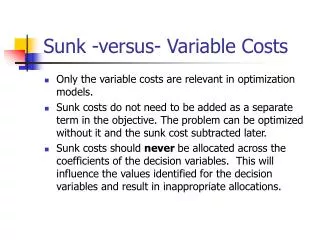
Sunk Costs Revisited • Sunk cost is one incurred in the past that can not be changed by current or future actions. • So, it is not an economic cost - not an opportunity cost - since if you have already lost something and can't get it back, then it is not something you will have to "give up" to get something else (now or in the future).
Sunk Costs Revisited • Lost $10 vs. lost a $10 movie ticket example from last time. • If you lost the movie ticket - you can't get it back - if you decide not to buy a second ticket and go home you won't get the first ticket you lost back.
Sunk Costs Revisited • Theory states: ignore sunk costs, because they are paid in either case, and cannot be recovered. E.G. you pay $7 for a movie ticket and decide half way through that it is terrible. Should you leave? • Stay: lost $7 and suffer through second half • Leave: lost $7
Sunk Costs Revisited • E.G. paid $15 for a concert ticket. The show is great, but after 45 minutes you are tired and are thinking about your long day tomorrow. Should you stay and “get your money’s worth”? • Question: when is the optimal time to leave? • At the end of the night, no matter what, you’re out $15 • Each moment your stay: • MB = additional enjoyment of concert • MC = lost sleep time • For each moment you are home early: • MB = sleep time and more productive day tomorrow • MC = missed remaining part of the concert • The $15 price that you paid should not enter this decision, either way you look at it.