Figurative Language
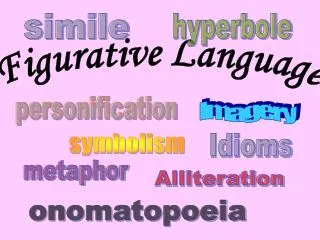
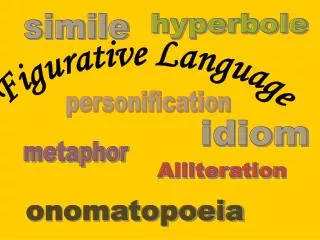
Figurative Language . Grades 6-8. What is figurative language?. Whenever you describe something by comparing it with something else, you are using figurative language. Types of Figurative Language. Imagery Simile Metaphor Alliteration Personification Onomatopoeia Hyperbole

Figurative Language
E N D
Presentation Transcript
Figurative Language Grades 6-8
What is figurative language? Whenever you describe something by comparing it with something else, you are using figurative language.
Types of Figurative Language • Imagery • Simile • Metaphor • Alliteration • Personification • Onomatopoeia • Hyperbole • Idioms
Simile A figure of speech which involves a direct comparison between two unlike things, usually with the words like or as. Example: The muscles on his brawny arms are strong as iron bands.
Imagery Language that appeals to the senses. Descriptions of people or objects stated in terms of our senses. • Hearing • Sight • Touch • Taste • Smell
Metaphor A figure of speech which involves an implied comparison between two relatively unlike things using a form of be. The comparison is not announced by like or as. Example: The road was a ribbon wrapped through the dessert.
Alliteration Repeated consonant sounds occurring at the beginning of words or within words. Example: She was wide- eyed and wondering while she waited for Walterto waken.
Personification A figure of speech which gives the qualities of a person to an animal, an object, or an idea. Example: “The wind yells while blowing.”The wind cannot yell. Only a living thing can yell
Onomatopoeia The use of words that mimic sounds. Example: The firecracker made aloud ka-boom!
Hyperbole An exaggerated statement used to heighten effect. It is not used to mislead the reader, but to emphasize a point. Example: She has said so on several million occasions.
Idioms An idiom or idiomatic expression refers to a construction or expression in one language that cannot be matched or directly translated word-for-word in another language. Example: "She has a bee in her bonnet," meaning "she is obsessed,“ cannot be literally translated into another language word for word.