Une image / un lien ci-dessous est fourni (tel quel) pour télécharger la présentation
Politique de téléchargement : le contenu du site vous est fourni TEL QUEL pour votre information et votre usage personnel ; il ne peut être vendu, concédé sous licence ni partagé sur d’autres sites sans l’accord de son auteur.Le contenu vous est fourni TEL QUEL, pour votre information et votre usage personnel uniquement.Téléchargez la présentation en cliquant sur ce lien.Lors du téléchargement, si vous ne parvenez pas à télécharger une présentation, l’éditeur a peut-être supprimé le fichier de son serveur.Pendant le téléchargement, si vous ne parvenez pas à obtenir une présentation, le fichier a peut-être été supprimé par l’éditeur.
F I N
Plus de contenu associé
Transcription de la présentation
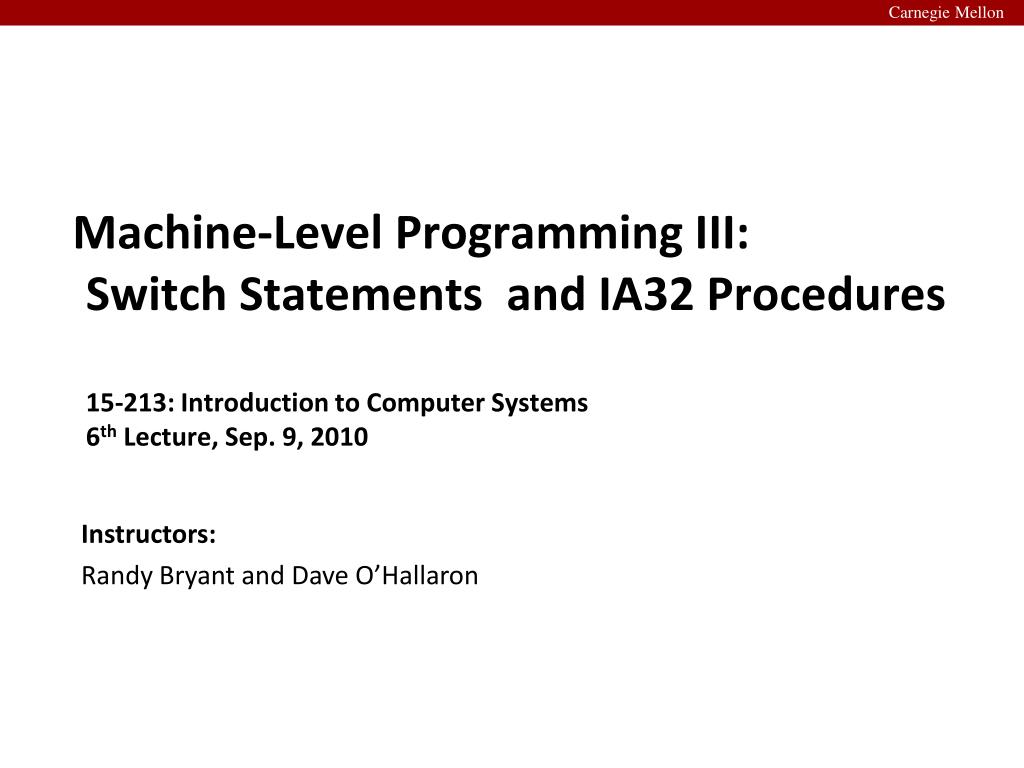
Carnegie Mellon Machine-Level Programming III:Switch Statements and IA32 Procedures15-213: Introduction to Computer Systems6th Lecture, Sep. 9, 2010 Instructors: Randy Bryant and Dave O’Hallaron
Carnegie Mellon Switch Statement Example long switch_eg (long x, long y, long z) { long w = 1; switch(x) { case 1: w = y*z; break; case 2: w = y/z; /* Fall Through */ case 3: w += z; break; case 5: case 6: w -= z; break; default: w = 2; } return w; } • Multiple case labels • Here: 5 & 6 • Fall through cases • Here: 2 • Missing cases • Here: 4
Carnegie Mellon Switch Statement Example (IA32) long switch_eg(long x, long y, long z) { long w = 1; switch(x) { . . . } return w; } What range of values takes default? Setup: switch_eg: pushl %ebp # Setup movl %esp, %ebp # Setup movl 8(%ebp), %eax # %eax = x cmpl $6, %eax # Compare x:6 ja .L2 # If unsigned > goto default jmp *.L7(,%eax,4) # Goto *JTab[x] Note that w not initialized here
Carnegie Mellon Switch Statement Example (IA32) long switch_eg(long x, long y, long z) { long w = 1; switch(x) { . . . } return w; } Jump table .section .rodata .align 4 .L7: .long .L2 # x = 0 .long .L3 # x = 1 .long .L4 # x = 2 .long .L5 # x = 3 .long .L2 # x = 4 .long .L6 # x = 5 .long .L6 # x = 6 Setup: switch_eg: pushl %ebp # Setup movl %esp, %ebp # Setup movl 8(%ebp), %eax # eax = x cmpl $6, %eax # Compare x:6 ja .L2 # If unsigned > goto default jmp *.L7(,%eax,4) # Goto *JTab[x] Indirect jump
Carnegie Mellon Assembly Setup Explanation • Table Structure • Each target requires 4 bytes • Base address at .L7 • Jumping • Direct:jmp .L2 • Jump target is denoted by label .L2 • Indirect:jmp *.L7(,%eax,4) • Start of jump table: .L7 • Must scale by factor of 4 (labels have 32-bits = 4 Bytes on IA32) • Fetch target from effective Address .L7 + eax*4 • Only for 0 ≤ x ≤ 6 Jump table .section .rodata .align 4 .L7: .long .L2 # x = 0 .long .L3 # x = 1 .long .L4 # x = 2 .long .L5 # x = 3 .long .L2 # x = 4 .long .L6 # x = 5 .long .L6 # x = 6
Carnegie Mellon Jump Table Jump table switch(x) { case 1: // .L3 w = y*z; break; case 2: // .L4 w = y/z; /* Fall Through */ case 3: // .L5 w += z; break; case 5: case 6: // .L6 w -= z; break; default: // .L2 w = 2; } .section .rodata .align 4 .L7: .long .L2 # x = 0 .long .L3 # x = 1 .long .L4 # x = 2 .long .L5 # x = 3 .long .L2 # x = 4 .long .L6 # x = 5 .long .L6 # x = 6
Carnegie Mellon Handling Fall-Through long w = 1; . . . switch(x) { . . . case 2: w = y/z; /* Fall Through */ case 3: w += z; break; . . . } case 3: w = 1; goto merge; case 2: w = y/z; merge: w += z;
Carnegie Mellon Code Blocks (Partial) switch(x) { case 1: // .L3 w = y*z; break; . . . case 3: // .L5 w += z; break; . . . default: // .L2 w = 2; } .L2: # Default movl $2, %eax # w = 2 jmp .L8 # Goto done .L5: # x == 3 movl $1, %eax # w = 1 jmp .L9 # Goto merge .L3: # x == 1 movl 16(%ebp), %eax # z imull 12(%ebp), %eax # w = y*z jmp .L8 # Goto done
Carnegie Mellon Code Blocks (Rest) switch(x) { . . . case 2: // .L4 w = y/z; /* Fall Through */ merge: // .L9 w += z; break; case 5: case 6: // .L6 w -= z; break; } .L4: # x == 2 movl 12(%ebp), %edx movl %edx, %eax sarl $31, %edx idivl 16(%ebp) # w = y/z .L9: # merge: addl 16(%ebp), %eax # w += z jmp .L8 # goto done .L6: # x == 5, 6 movl $1, %eax # w = 1 subl 16(%ebp), %eax # w = 1-z
Carnegie Mellon x86-64 Switch Implementation • Same general idea, adapted to 64-bit code • Table entries 64 bits (pointers) • Cases use revised code Jump Table .section .rodata .align 8 .L7: .quad .L2 # x = 0 .quad .L3 # x = 1 .quad .L4 # x = 2 .quad .L5 # x = 3 .quad .L2 # x = 4 .quad .L6 # X = 5 .quad .L6 # x = 6 switch(x) { case 1: // .L3 w = y*z; break; . . . } .L3: movq %rdx, %rax imulq %rsi, %rax ret
Carnegie Mellon Summarizing • C Control • if-then-else • do-while • while, for • switch • Assembler Control • Conditional jump • Conditional move • Indirect jump • Compiler generates code sequence to implement more complex control • Standard Techniques • Loops converted to do-while form • Large switch statements use jump tables • Sparse switch statements may use decision trees
Stack “Bottom” Increasing Addresses Stack Grows Down Stack Pointer: %esp Stack “Top” Carnegie Mellon IA32 Stack • Region of memory managed with stack discipline • Grows toward lower addresses • Register %esp contains lowest stack address • address of “top” element
Stack Pointer: %esp -4 Stack “Top” Carnegie Mellon IA32 Stack: Push Stack “Bottom” • pushl Src • Fetch operand at Src • Decrement %esp by 4 • Write operand at address given by %esp Increasing Addresses Stack Grows Down
+4 Carnegie Mellon IA32 Stack: Pop Stack “Bottom” Increasing Addresses Stack Grows Down Stack Pointer: %esp Stack “Top”
Carnegie Mellon Procedure Control Flow • Use stack to support procedure call and return • Procedure call:calllabel • Push return address on stack • Jump to label • Return address: • Address of the next instruction right after call • Example from disassembly 804854e:e8 3d 06 00 00 call 8048b90 <main> 8048553:50 pushl %eax • Return address = 0x8048553 • Procedure return:ret • Pop address from stack • Jump to address
Carnegie Mellon Procedure Return Example 8048591: c3 ret ret 0x110 0x110 0x10c 0x10c 0x108 123 0x108 123 0x104 0x8048553 0x8048553 %esp 0x104 %esp 0x108 %eip 0x8048591 %eip 0x8048553 %eip: program counter
Carnegie Mellon Stack-Based Languages • Languages that support recursion • e.g., C, Pascal, Java • Code must be “Reentrant” • Multiple simultaneous instantiations of single procedure • Need some place to store state of each instantiation • Arguments • Local variables • Return pointer • Stack discipline • State for given procedure needed for limited time • From when called to when return • Callee returns before caller does • Stack allocated in Frames • state for single procedure instantiation
Carnegie Mellon Call Chain Example Example Call Chain yoo(…) { • • who(); • • } yoo who(…) { • • • amI(); • • • amI(); • • • } who amI amI amI(…) { • • amI(); • • } amI amI Procedure amI() is recursive
Carnegie Mellon Stack Frames • Contents • Local variables • Return information • Temporary space • Management • Space allocated when enter procedure • “Set-up” code • Deallocated when return • “Finish” code Frame Pointer: %ebp Stack Pointer: %esp Stack “Top”
%ebp %esp Carnegie Mellon Example Stack yoo yoo(…) { • • who(); • • } yoo who amI amI amI amI
%ebp %esp Carnegie Mellon Example Stack yoo yoo(…) { • • who(); • • } yoo who(…) { • • • amI(); • • • amI(); • • • } who amI amI amI amI
%ebp %esp Carnegie Mellon Example Stack yoo yoo(…) { • • who(); • • } yoo who(…) { • • • amI(); • • • amI(); • • • } amI(…) { • • amI(); • • } who amI amI amI amI
%ebp %esp Carnegie Mellon Example Stack yoo yoo(…) { • • who(); • • } yoo who(…) { • • • amI(); • • • amI(); • • • } amI(…) { • • amI(); • • } who amI(…) { • • amI(); • • } amI amI amI amI
%ebp %esp Carnegie Mellon Example Stack yoo yoo(…) { • • who(); • • } yoo who(…) { • • • amI(); • • • amI(); • • • } amI(…) { • • amI(); • • } who amI(…) { • • amI(); • • } amI amI amI(…) { • • amI(); • • } amI amI
%ebp %esp Carnegie Mellon Example Stack yoo yoo(…) { • • who(); • • } yoo who(…) { • • • amI(); • • • amI(); • • • } amI(…) { • • amI(); • • } who amI(…) { • • amI(); • • } amI amI amI amI
%ebp %esp Carnegie Mellon Example Stack yoo yoo(…) { • • who(); • • } yoo who(…) { • • • amI(); • • • amI(); • • • } amI(…) { • • amI(); • • } who amI amI amI amI
%ebp %esp Carnegie Mellon Example Stack yoo yoo(…) { • • who(); • • } yoo who(…) { • • • amI(); • • • amI(); • • • } who amI amI amI amI
%ebp %esp Carnegie Mellon Example Stack yoo yoo(…) { • • who(); • • } yoo who(…) { • • • amI(); • • • amI(); • • • } amI(…) { • • amI(); • • } who amI amI amI amI
%ebp %esp Carnegie Mellon Example Stack yoo yoo(…) { • • who(); • • } yoo who(…) { • • • amI(); • • • amI(); • • • } who amI amI amI amI
%ebp %esp Carnegie Mellon Example Stack yoo yoo yoo(…) { • • who(); • • } who amI amI amI amI
Carnegie Mellon IA32/Linux Stack Frame • Current Stack Frame (“Top” to Bottom) • “Argument build:”Parameters for function about to call • Local variablesIf can’t keep in registers • Saved register context • Old frame pointer • Caller Stack Frame • Return address • Pushed by call instruction • Arguments for this call Caller Frame Arguments Frame pointer%ebp Return Addr Old %ebp Saved Registers + Local Variables Argument Build Stack pointer %esp
Switch statements IA 32 Procedures Stack Structure Calling Conventions Illustrations of Recursion & Pointers Carnegie Mellon Today
Carnegie Mellon Register Saving Conventions • When procedure yoo calls who: • yoo is the caller • who is the callee • Can register be used for temporary storage? • Contents of register %edx overwritten by who • This could be trouble ➙ something should be done! • Need some coordination yoo: • • • movl$15213, %edx call who addl%edx, %eax • • • ret who: • • • movl8(%ebp), %edx addl $18243, %edx • • • ret
Connexion au compte
Connectez-vous pour publier votre contenu sur SlideServe.