Employee Appraisals
320 likes | 444 Vues
This guide outlines the formal, structured process of employee performance appraisals, focusing on evaluating and influencing job-related attributes and outcomes. It explains the purpose of appraisals—supporting management decisions, training, retention, promotion, and reward. Key topics include when to conduct appraisals, critical competencies to evaluate, various appraisal systems like rating scales, 360-degree evaluations, and the importance of constructive discussions during the review process. This resource aims to enhance evaluation effectiveness and employee development for improved organizational performance.


Employee Appraisals
E N D
Presentation Transcript
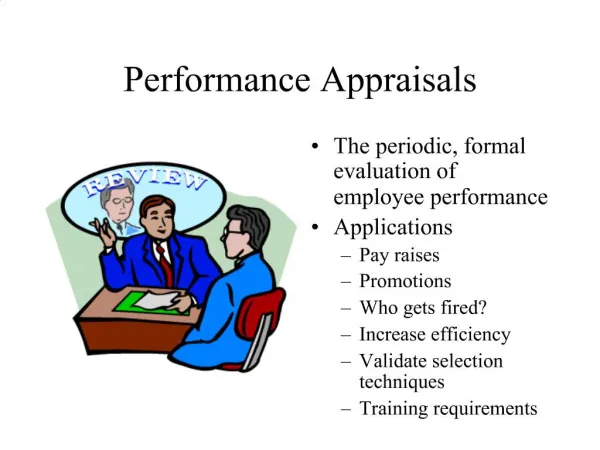
Performance Appraisals • The formal structured system for measuring, evaluating, & influencing an employee’s job related attributes, behaviors, and outcomes
Why do them? • To make management decisions • Training…developmental • Retaining…developmental • Promoting…administrative • Rewarding…administrative
What should be evaluated • Job specific competencies • Written & oral communication • Supervision & leadership • Management & administration • Avoid personality unless it impacts job performance
When should appraisals be conducted? • Anniversary dates • End of the calendar/fiscal year • 1-2 x’s per year • Probationary employees • end of probation, midterm, annually
Appraisal Systems • 3 basic needs • A description of relevant behaviors that everyone agrees is critical to job performance (core & job specific) • A method to collect & evaluate data on the behavior of the person being evaluated • The ability to have a constructive discussion
Appraisal Systems • A description of relevant behaviors that everyone agrees is critical to job performance • Competencies with general definitions Takes Initiative – Proactively initiates changes or takes action to improve efficiency, address existing and potential problems, and satisfy customers. Rating: ________
Appraisal Systems Customer Service – Activities designed to enhance the experience of visitors before, during and after purchase/interaction. Rating: ________ Effective written communication – Written documents that are free of errors and express thoughts, purposes and ideas clearly. Rating: ________
Appraisal Systems • A method to collect & evaluate data on the behavior of the person being evaluated • Rating scales • Forced distribution • Critical incidents • MBO • 360 degree evaluations
Rating Scales • Form with listed criteria • Submits reports promptly Excellent Good Fair Poor 4 3 2 1 • Examples
Rating Scales • Problems with rating scales • Halo effect • Carry over success in 1 area to all areas • Organizational skills are strong, assume leadership is strong • Influence of a person’s job • Assume the higher in the organization the better they perform
Rating Scales • Problems with rating scales • Different perceptions • Impartiality is difficult • CPD – compete for $ with other depts. • Excessive leniency or strictness
Forced Distribution • Rank order ee within a class • Used to distribute money • Like grading on a curve
Forced Distribution • Weaknesses • Assumes not everyone can be top performers • May penalize workers meeting all expectations
Critical Incidents • Determine critical incidents for the job • Evaluate extent to which ee fulfills the critical incidents • Mgr keeps a record of how ee handles C.I.’s • Allows manager to use + & - egs. • Eg….
Critical Incidents • Weaknesses • Mgr too focused on recording people’s actions • Seen as keeping a file on the ee
MBO • Look at org & indiv g & o • Evaluate on mutually agreed upon objectives • Beneficial to both agency & ee • Individual has control over eval
MBO • Weaknesses • Time consuming • EE & mgr must agree on obj. • There are functions that are difficult to put into a measurable objective • Creativity, play well with others • Have to be able to write quality, measurable objectives
360 Evaluation Direct supervisor, peers & subordinates Helps ee see themselves as others see them Gives a better perspective of performance Biggest issue: confidentiality
Appraisal Systems • The ability to have a constructive discussion • Tips….
Appraisal Systems • Constructive discussion tips… • Set a meeting in advance with the employee • Do not put off the meeting • 30-60 minutes • Have a written eval that is discussed orally • Self evaluations
Appraisal Systems • Constructive discussion tips… • 30 minute screening period for the employee • Why?
Appraisal Systems • Constructive discussion tips… • Conduct the meeting systematically • Non-threatening, 2 way conversation • Explain your appraisal • Ask for comments, ?’s • Discuss plan for the future…career building • Focus is to max. performance in the future, not dwelling on the past
Appraisal Systems • Constructive discussion tips… • End result – action plan for the next evaluation period • Have no surprises • Have ee sign the form • Give time for written comments • Place the form in the ee file