Modeling Pb++ Transport in Dual Porosity Aquifer with Variable Inlet Fluid Composition
80 likes | 200 Vues
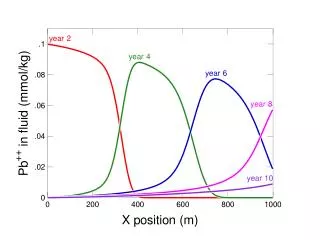
This study outlines an advanced model for simulating lead (Pb++) transport in a dual porosity aquifer. The model defines inlet fluid characteristics over two distinct intervals—initially introducing Pb++ from 0 to 2 years, followed by clean rinse water until 10 years. The aquifer spans 1 km, segmented into 400 nodal blocks, allowing for precise flow rate adjustments and mass transport calculations. The dual porosity framework incorporates both free-flowing and stagnant zones, providing insights on hydrodynamic dispersion and contaminant behavior in complex subsurface environments.


Modeling Pb++ Transport in Dual Porosity Aquifer with Variable Inlet Fluid Composition
E N D
Presentation Transcript
Specify domain’s starting fluid composition on the Initial pane Clean water Start and end times of two reaction intervals
Inlet fluid enters the domain from t = 0 to 2 years Inlet fluid carries Pb++pulse into the domain
Inlet 2 fluid enters the domain from t = 2 to 10 years Clean rinse water: negligible Pb++in the second inlet fluid
Specify domain size, gridding, and flow rate on the Domain pane. Domain is 1 km long, divided into 400 nodal blocks Set flowrate for 1st and 2nd reaction intervals Set specific discharge or head drop
Set various mass transport properties on the Medium pane. Porosity of the free-flowing zone. Used to calculate coefficient of hydrodynamic dispersion.
In a dual porosity model, each nodal block is divided into a free-flowing zone and a stagnant zone. Config → Dual Porosity… On/off toggle 40% of the aquifer is stagnant. Characteristic dimension of the stagnant zone Run → Go traces the model
Pb++travels from one nodal block to another only through the free-flowing volume, but it can diffuse into and out of the stagnant zones.