Download
1 / 12
120 likes | 231 Vues
This article explores the informal strategies children use in mathematical problem-solving, particularly within the framework of Cognitively Guided Instruction. It outlines various strategies, such as direct modeling and counting, and discusses different problem types, including joining, separating, part-part-whole, and comparison problems. Each type is exemplified with scenarios involving children like Jim and Sue to illustrate how they approach these problems. Understanding these strategies can enhance teaching practices and help educators support students’ mathematical development effectively.

E N D
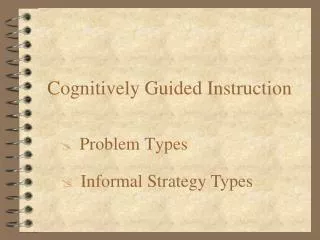
Cognitively Guided Instruction ProblemTypes • Informal Strategy Types
Children’s Informal Strategies Direct Modeling -- Children “act out” the problem. They are very literal. They model every number and work the problem in chronological order.
Children’s Informal Strategies Counting Strategy -- The child does not model every number in the problem. The child “stores” one number and counts up or back to solve the problem.
Children’s Informal Strategies Derived Fact -- The child uses a known number relationship to figure out the desired relationship.
Problem Types Join -- The action in these problems is a joining of two sets. The unknown quantity can be either the result, the change, or the start.
Result Unknown: Jim had 8 marbles. Sue gave him 4 more. How many marbles does Jim have now? 8 + 4 = ? Change Unknown: Jim had 8 marbles. Sue gave him some more. Now Jim has 12 marbles. How many marbles did Sue give Jim? 8 + ? = 12 Join -- The action in these problems is a joining of two sets. Start Unknown: Jim had some marbles. Sue gave him 4 more. Now Jim has 12 marbles. How many marbles did Jim have to start with? ? + 4 = 12
Problem Types Separate -- The action in these problems is taking a subset out of a set. The unknown quantity can be either the result, the change, or the start.
Result Unknown: Jim had 12 cookies. He ate 4. How many cookies does Jim have now? 12 - 4 = ? Change Unknown: Jim had 12 cookies. He ate some. Now Jim has 8 cookies. How many cookies did Jim eat? 12 - ? = 8 Separate -- The action in these problems is taking a subset out of a set. Start Unknown: Jim had some cookies. He ate 4. Now Jim has 8 cookies. How many cookies did Jim have to start with? ? - 4 = 8
Problem Types Part-Part-Whole -- There is no action. A set (whole) with defined subsets (parts) is described. The unknown quantity can be either one of the parts or the whole.
Whole Unknown: Jim had 8 red marbles and 4 blue marbles. How many marbles does Jim have in all? Part-Part-Whole -- There is no action. A set (whole) with defined subsets (parts) is described. Part Unknown: Jim had 8 red marbles. The rest are blue. Jim has 12 marbles in all. How many are blue?
Problem Types Comparison -- There is no action. The size of two sets is compared. The unknown quantity can be either the difference between the sets or one of the sets.
Difference Unknown: Jim had 8 marbles. Sue had 12 marbles. How many more marbles does Sue have than Jim? Large Set Unknown: Jim has 8 marbles. Sue has 4 more than Jim. How many marbles does Sue have? Comparison -- There is no action. The size of two sets is compared. Small Set Unknown: Sue has 12 marbles. Jim has 4 fewer marbles than Sue. How many marbles does Jim have?