Download
1 / 11
110 likes | 257 Vues
The AHRCC Cultural Exchange Project (Feb 14 - May 13, 2013) by Deborah Harty investigated drawing as a phenomenological experience, focusing on its impact when sight is removed. Collaborating with RNIB College Loughborough and My Sight Nottingham, the research examined how drawing through touch affects perception and understanding. Participants recorded their tactile experiences, creating a unique form of drawing that heightened inclusivity and facilitated discussion. Initial findings suggest that drawing can illuminate insights for both sighted and non-sighted individuals, expanding our understanding of perception beyond visual experience.

E N D
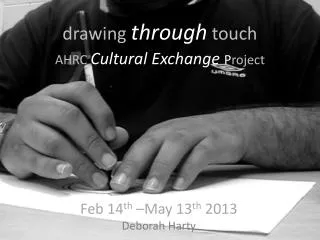
drawingthroughtouch AHRCCultural Exchange Project Feb 14th –May 13th2013 Deborah Harty
Drawingis said to be phenomenological, that is, capable of recordingits own makingand the movementof the thoughtsandbodyof the drawer.
Working in collaborationwith users of the RNIBCollegeLoughborough and My Sight Nottingham, the research sought to ascertain: • if this premiseisaffectedwhen the sense of sight, as the predominantsense, is removedanddrawingcommences predominantly throughtouch; • whether drawing processes coulddevelopthe participators’understandingof the worldaround them.
Drawingwas utilised as a means to recordtheexperience of participatorsexploringandperceivinganobjectthroughtouch. Theirexperienceswererecordedthroughdrawingontopaperdesigned to raisethe black linesof the drawing when heat-treated.
This allowed the participators to ‘see’ and re-experience their drawings through touching and retracing the tactile drawings they created.
The drawing tactiles were re-experienced through touch and shared amongst the group to allow all participators to experience each other’s drawings. This offered the participators an alternative way of considering the objects they were asked to draw, more importantly it offered reciprocal insights into how sighted/non-sighted perceive the world.
A further unanticipatedconsequencewas the level of satisfactionthe participatorsexperiencedduring and afterdrawing. In some instances, particularly for those that arecongenitally blind,this was due to a feeling of inclusivityinto a domainnormally not accessible to them – visual arts.
The shared group activity of drawing initiated a convivial atmosphere promoting free-flowing discussion and a willingness to share experiences and discoveries. Several participators indicated a desire to show their drawings and were willing to lead discussions as to what they had discovered through the process of drawing and what they had been attempting to communicate through their mark-making.
The research is still in its infancy, however, initial findings suggest that drawing can be beneficial to those without sight, offering insights into both sighted and non-sighted worlds. In much the same way that drawing through attentive looking develops understanding of the world, drawing through attentive touch has the potential to do so also. This suggests that the phenomenology of drawing is not necessarily specifically linked to sight …