
Autonomous Helicopter Mapping
E N D
Presentation Transcript
Autonomous Helicopter Mapping Andrew Ng, Mark Diel, Eric Berger, Adam Coates, Varun Ganapathi, Eric Liang, Dirk Hähnel, Rahul Biswas, Sebastian Thrun Stanford University Contact: thrun@stanford.edu, ang@cs.stanford.edu DARPA MARS IPR, Sept 23-24, 2003
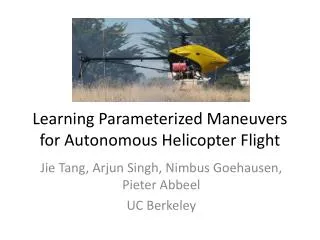
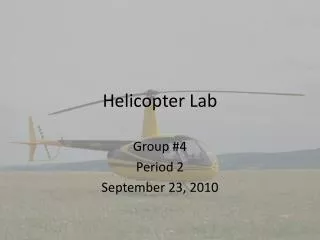
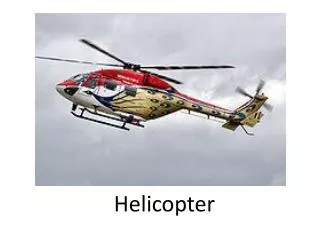
The Stanford Autonomous Helicopter Payload: 14 pounds Weight: 32 pounds • 6-Month Goals: • Flight near obstacles, caves • Maintenance-free hardware DARPA MARS IPR, Sept 23-24, 2003
The Stanford Autonomous Helicopter Magnetometer GPS IMU 802.11b PC 104 SICK lite (3.7 pounds) Intel Stayton Payload: 14 pounds Weight: 32 pounds • 6-Month Goals: • Flight near obstacles, caves • Maintenance-free hardware DARPA MARS IPR, Sept 23-24, 2003
Classical Approach: m-Synthesis Control DARPA MARS IPR, Sept 23-24, 2003
Our Approach: Reinforcement Learning DARPA MARS IPR, Sept 23-24, 2003
Classical Approach 1,000 hours of hand-tuning IMU, GPS EKF controller controls state Machine Learning Approach 3.5 minutes of flight data 10 minutes of reinforcement learning IMU, GPS EKF model controller controls state Our Approach: Reinforcement Learning DARPA MARS IPR, Sept 23-24, 2003
Four-legged walking Same learning algorithm used to control complex, very high dimensional (36D), underactuated robots. [with Lawrence and Tal] DARPA MARS IPR, Sept 23-24, 2003
Mapping (Autonomous Flight) DARPA MARS IPR, Sept 23-24, 2003
Mapping (Autonomous Flight) DARPA MARS IPR, Sept 23-24, 2003
Results (Map) WARNING: These are VRML files – you will have to edit the path to those files! Raw data Map Red = wall White = Road Green = Vegetation Yellow = Obstacle DARPA MARS IPR, Sept 23-24, 2003
Conclusions • Autonomous flight in 11 days. • Integrated flight and mapping. • Next steps: • Robust flight in confined spaces. • Coordinated ground/air mapping and navigation. DARPA MARS IPR, Sept 23-24, 2003