Download
1 / 18
180 likes | 291 Vues
Delve into the impact of a novel rule in genomics where words and their reverse complements share occurrence ratios. Calculate ratios for specified words, plot correlations, search for power law patterns, and compare dimer frequencies in Bacillus subtilis and Clostridium perfringens. Uncover insights into chromosome structure and genomic patterns with this intriguing study.

E N D
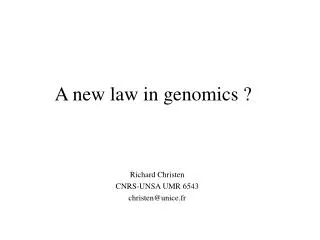
A new law in genomics ? Richard Christen CNRS-UNSA UMR 6543 christen@unice.fr
Ci-joint un des articles auquel je pensais pendant ton coup de fil. Amicalement, Jean R. Lobry
Watson Crick ATCGAGTC TAGCTCAG ==> If ATCGAGTC is present in one strand, GACTCGAT is present in the other strand. ==> If a word is present in p copies in one strand its reverse complement is present in p copies in the other strand.
The new rule If a word is present in p copies in one strand its reverse complement is also present in p copies in the same strand. !!!!!!!!
Calculate ratios A k-word AGCGTAGTC present P1 times in a sequence its reverse-complement GACTACGCT present P2 times in same sequence its complement TCGCATCAG present P3 times in same sequence its reverse CTGATGCGA present P4 times in same sequence Lets plot P1/P2, P1/P3, P1/P4 and compare ...
Searching for words ? W= 9 X axis : number of occurrences of a given word Y axis : number of different words with same frequency of occurrence
Searching for words ? Searching for a power law in genomes…. X axis : log(number of occurrences of a given word) Y axis : number of different words with same occurrences
X axis : number of occurrences of a given word Y axis : number of different words with same occurrences ==> 7 categories of words
! Expected : 6.25 if GC%=AT% ==> from the composition of a word, I can predict its frequency !!!
Bacillus subtillis In B. subtilis, comparison on each side of the origin of replication Leading strand versus lagging strand





![[III] Genes, Genomics, and Chromosomes](https://cdn1.slideserve.com/3548265/iii-genes-genomics-and-chromosomes-dt.jpg)