Reevaluating Regional Nitrogen Rate Guidelines for Corn: A Yield-Based Perspective
30 likes | 170 Vues
This document addresses key issues with existing nitrogen (N) rate guidelines for corn, particularly the inconsistencies between recommended rates and economically optimal N rates (EONR) derived from response trials. Concerns include the determination of yield goals, the assumption of constant Nitrogen Use Efficiency (NUE) across different sites and years, and the inadequacy of adjustments for non-fertilizer N sources. Observations indicate that optimum N rates can fluctuate over time, potentially reflecting improved N utilization and soil N supply rather than a straightforward trend in requirements.


Reevaluating Regional Nitrogen Rate Guidelines for Corn: A Yield-Based Perspective
E N D
Presentation Transcript
Concepts and Rationale for Regional Nitrogen Rate Guidelines for Corn
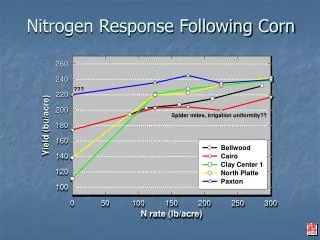
Yield-based approach to N recommendations has been questioned • Poor relationship between recommendations and EONR from N rate response trials • Uncertainly about how yield goals should be determined • Assumption that NUE is constant across sites anyears • Use of inadequate or inappropriate adjustments for nonfertilizer N sources
Data showed that optimum N rates increased over time at one site and decreased at the other site • Results provide no clear indication of a change in N rates over time • Reasons for similar or decreasing optimum N rates where yields have increased substantially include more efficient utilization of available N by the crop and increased soil N supplying capability