Innovations in Underwater Adhesives Inspired by Edible Mussel Mytilus edulis
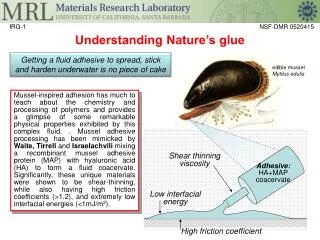
This research explores the unique adhesive properties of the edible mussel Mytilus edulis, focusing on the fluid mechanics involved in creating underwater adhesives. Researchers Waite, Tirrell, and Israelachvili have successfully mimicked mussel adhesion by combining recombinant mussel adhesive protein (MAP) with hyaluronic acid (HA), resulting in a shear-thinning coacervate. This novel material exhibits remarkable physical properties, including high friction coefficients and low interfacial energies, providing valuable insights into the chemistry and processing of advanced polymer systems.

Innovations in Underwater Adhesives Inspired by Edible Mussel Mytilus edulis
E N D
Presentation Transcript
IRG-1 NSF-DMR 0520415 Understanding Nature’s glue edible mussel Mytilus edulis Getting a fluid adhesive to spread, stick and harden underwater is no piece of cake Mussel-inspired adhesion has much to teach about the chemistry and processing of polymers and provides a glimpse of some remarkable physical properties exhibited by this complex fluid.. Mussel adhesive processing has been mimicked by Waite, TirrellandIsraelachvilimixing a recombinant mussel adhesive protein (MAP) with hyaluronic acid (HA) to form a fluid coacervate. Significantly, these unique materials were shown to be shear-thinning, while also having high friction coefficients (>1.2), and extremely low interfacial energies (<1mJ/m2). Shear thinning viscosity Adhesive: HA+MAP coacervate Low interfacial energy High friction coefficient