Download
1 / 9
90 likes | 191 Vues
This study evaluates the export efficiency of black carbon (BC) emissions from East Asia, focusing on their implications for global budgets and deposition in the Arctic. Using data from the TRACE-P mission, we analyze BC's solubility and model the time scale required for the conversion of hydrophobic to hydrophilic BC. Key findings include a BC atmospheric lifetime of approximately 5.8 days, a global burden of 0.11 Tg, and an estimated impact of BC on Arctic snow albedo reduction by about 3.2%. These insights are vital for enhancing climate models.

E N D
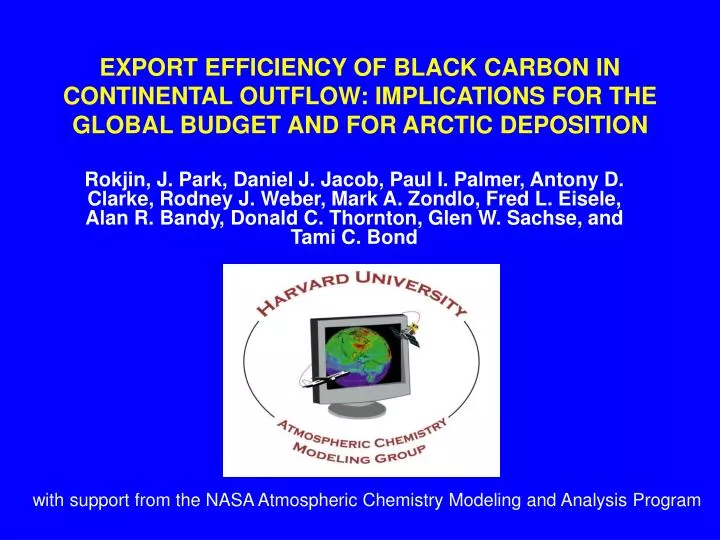
EXPORT EFFICIENCY OF BLACK CARBON IN CONTINENTAL OUTFLOW: IMPLICATIONS FOR THE GLOBAL BUDGET AND FOR ARCTIC DEPOSITION Rokjin, J. Park, Daniel J. Jacob, Paul I. Palmer, Antony D. Clarke, Rodney J. Weber, Mark A. Zondlo, Fred L. Eisele, Alan R. Bandy, Donald C. Thornton,Glen W. Sachse, and Tami C. Bond with support from the NASA Atmospheric Chemistry Modeling and Analysis Program
BC IN THE ATMOSPHERE BC is operationally defined as the light-absorbing fraction of carbonaceous aerosols. CHEMICAL AGING WET DEPOSITION PRIMARY EMISSION coating by sulfate or organics oxidation Hydrophobic Hydrophilic How long ()? How much? Most global models assume = 1 day for chemical conversion of hydrophobic to hydrophilic BC.
OBJECTIVES • Assess BC export efficiencies in Asian outflow over the NW pacific constrained by aircraft observations from the TRACE-P mission (Feb-Apr 2001). - Comparison of the BC observations [Clarke et al., 2004] with soluble and insoluble species offers constraints on BC solubility. • Determine the model time scale () for conversion of fresh hydrophobic to hydrophilic BC as constrained by the TRACE-P observations. • Examine implications for the BC global burden and its deposition flux to the Arctic (“dirty snow”).
EXPORT EFFICIENCY BC emissions over East Asia are highly uncertain [Carmichael et al, 2003]. [Koike et al., 2003; Parrish et al, 2004] X = combustion-derived species RX = emission ratio (X/CO) Δ = enhancements relative to background NORMALIZED EXPORT EFFICIENCY INDEPENDENT OF EMISSION RATIO, R We use the TRACE-P P-3B data north of 30oN for which China provided a common source region.
OBSERVED EXPORT EFFICIENCYBC vs SOX(≡SO2(g)+SO42-) and HNO3T(≡HNO3(g)+NO3-) Export efficiency Normalized export efficiency BC AEROSOLS ARE SIGNIFICANTLY SOLUBLE BUT NOT AS MUCH AS SULFATE OR NITRATE.
MEAN PROFILES OF SOX, fine NO3-, BC GEOS-CHEM chemical tracer model vs. TRACE-P observations P3B DATA over NW Pacific (30 – 45oN, 120 – 140oE) No significant model bias in SOx and NO3- indicates successful simulation of scavenging in Asian outflow. Model underestimates BC observations by factor of 2; insufficient emissions [Bond et al., 2004] or excessive scavenging?
BC NORMALIZED EXPORT EFFICIENCY IN ASIAN OUTFLOW (GEOS-CHEM vs TRACE-P ) Simulation with = 1±1 days for BC scavenging provides the best fit to the TRACE-P observations.
IMPLICATION FOR CLIMATE BC BURDEN & ARCTIC DEPOSITION FLUX BC lifetime is 5.8 ± 1.8 days, 50% longer than that of sulfate, global burden is 0.11 ± 0.03 Tg using Bond et al. [2004] inventory, and resulting decrease in Arctic snow albedo = 3.2 ± 2.5% with = 1 ± 1 days from the TRACE-P constraints
CONCLUSIONS • Global model simulations of BC for assessment of climate • impacts are highly sensitive to the assumed scavenging • efficiency of BC by precipitation. • Comparison of normalized export efficiencies for BC, SOx, • HNO3T in Asian outflow indicates that BC is scavenged in wet • updrafts but not to the extent of sulfate or nitrate. • The current model parameterizations, based on direct • emission of hydrophobic BC and conversion to hydrophilic • BC on a time scale of τ days, are consistent with vertical • profiles observed in Asian outflow if τ = 1±1 days. • The export efficiency of BC is 50% at 4 km altitude, • the atmospheric lifetime is 5.8±1.8 days, the global burden • is 0.11±0.03 Tg using Bond et al. [2004] inventory, and the • decrease in Arctic snow albedo due to BC is 3.1±2.5%.