Impact of Tire Size on Vehicle Mileage and Speed: A Comprehensive Guide
Discover how changing tire sizes can influence your vehicle's mileage and speed. This guide provides a detailed breakdown of the calculations involved in determining tire circumference and the effects on actual distance traveled and speed readings. Learn to find the width, aspect ratio, and diameter of tires, and understand the implications of these changes on your vehicle's performance. Additionally, we explore practical examples and provide essential formulas to accurately assess tire size impacts.


Impact of Tire Size on Vehicle Mileage and Speed: A Comprehensive Guide
E N D
Presentation Transcript
Warm up: Free write • In 20+ words, • How do you think changing the tire size on a vehicle will affect mileage or speed?
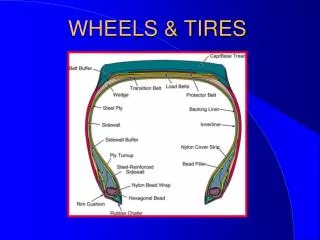
Finding the Circumference of a Tire • List width and Aspect ratio • Use Aspect ratio = H/W to find H • Divide by 25.4 mm to change h to inches • Find D= 2H+R ,where R is the (Rim Diameter) • Find Circumference.
LT 265/75R16 Example • Step 1 • W=265 mm • Aspect ratio= 75% • R= 19 inch • Step 2 • H=198.75 mm
Step 3 • 198.75mm/25.4mm = 7.82 inches • Step 4 • D=2H+R • D=2(7.82)+16 • D=31.64 inches
Step 5 • C=D • C=3.14 (31.64) • C=99.3496
Effect of changing factory –installed Tires • The following principles apply when determining actual distance and speed traveled according to tire size: • Actual mileage = k • odometer reading (mileage) • Actual speed = k • speedometer reading (miles per hour) • where k = • circumference of bigger tire • circumference of factory-installed tire • Since the value of k = 1.1128 for the two tires in comparison, 1.1128(20,000) = 22,256 • miles (actual) and 1.1128(60) = 66.768 miles per hour (actual).