Understanding Solutions: Mixtures, Types, and Colligative Properties in Chemistry
This comprehensive guide explores solutions, defined as homogeneous mixtures of solutes and solvents. Discover the solubility concept, the effects of temperature, pressure, and agitation, as well as unique terms like "like dissolves like." Learn about saturation levels and different types of solutions such as suspensions and colloids. Additionally, we cover colligative properties, concentration measures, and methods for calculating various solution properties including boiling point elevation and freezing point depression, providing you with essential knowledge in chemistry.


Understanding Solutions: Mixtures, Types, and Colligative Properties in Chemistry
E N D
Presentation Transcript
Solutions Dr. MuonHazlett Mandeville High School
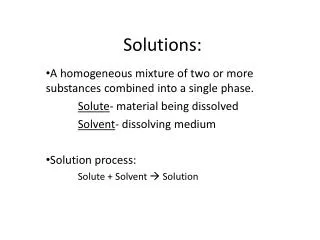
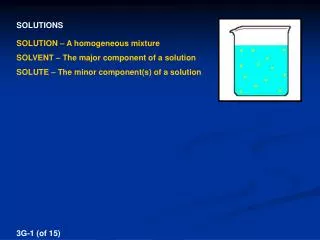
Solutions (solns) • Definition: • It is a homogeneous mixture • It is made up of a solute (what is being dissolved) and a solvent (what the solute is dissolved in) • Solute + Solvent = Solution • It can be a gas, liquid, or a solid or even a combination of these phases • It does not separate into its parts on its own
Solubility • If a solute dissolves in a solvent, it is soluble • Solubility affected by Temperature, Pressure, Agitation, etc. • The process in which the solvent particles surround the solute and “cause” it to dissolve is called solvation • If this occurs in water – called hydration • Rule of Solvation – “Like Dissolves Like”
Rule of Solvation • “Like Dissolves Like” • Refers to polar solutes dissolving in polar solvent, but not in nonpolar solvents • This is due to the charges found on the molecules and opposite charges attracting each other • If it does mix – said to be miscible, and if doesn’t – immiscible • Immiscible mixtures are not solutions since they will filter or separate on their own • Like oil and water
If the solute is an ionic compound and is dissolving completely, it is breaking down into its cations and anions • This is called ionization • Dependent upon the dissociation energy (Do), the energy needed to break apart the ionic compound • This is a part of the solvation process
Saturation • Saturation refers to the level of solute in the solvent • If the solvent can not dissolve any more solute, then the two are in equilibrium and the solution is saturated • If the solute “falls” out of the solvent – oversaturation • If not enough solute - undersaturated
Solution Types • Suspension - the solute will filter out of the solvent on its own (dirt in water) • Thixotrope - the solute and solvent adt as a solid until agitated, then it acts as a liquid • Emulsion - a liquid with a solid solute dissolved in it • Aerosol - a colloid using a gas as a propellant • Colloid - a heterogeneous mixture, the solute does not settle from solvent
Colligative Properties of Solns • Properties of solns that depend on the number of solute particles in the solvent • Vapor Pressure – affecting evaporation rates. This is amount of solvent found in gas phase above the solution. Lowers vapor pressure. • Boiling Point – more solute, higher the Bp • Freezing Point – more solute, lower Fp • Osmotic Pressure – affects the passing through of semi-permeable membranes
Concentration [C] • Concentration symbolized by brackets [ ] • Refers to amount of solute in the solvent • Common measures are ppm (parts per million) or ppb (parts per billion)
Concentration Formula • General: • C = mass of solute mass of soln • % C = mass of solute x 100 mass of soln • C ppm = mass of solute x 106 mass of soln
4. mass soln = mass of solute C 5. mass solute = C x mass solvent (1 - C) 6. Soln = solute + solvent 7. Volume % = vol. solute x 100 vol. soln
Molarity (M) • Gives the number of moles of solute per liter of soln • M = mols of solute = (n) liters of soln V *Remember n = mass/molar mass
Molality (m) • Gives the number of mols of solute per kg of solvent • m = mols solute = n kg solvent kg *Remember – 1 L = 1 kg 1 ml = 1 g = 1 cm3
Dilution • Mixing one substance into another to lower the concentration levels • M1V1 = M2V2 • Molarity x Volume initial = Molarity x Volume final • Rearrange the formula to determine individual variables • For multiple solns: • (M1V1) + (M2V2) = MdilutedsolnVdilutedsoln
Mole Fraction • Ratio of mols of solute or solvent to the total number of mols in soln • XA = solvent mol fraction = nA__ nA + nB XB = solute mol fraction = ___nB__ nA + nB
Calculating Colligative Properties • Vapor Pressure Lowering: • Δ PV = XB PA◦ • Where Δ PV is change in vapor pressure; XB is solute mol fraction; and PA◦ is vapor pressure of pure solvent found in a reference source like the CRC
Boiling Point Elevation: Δ BP = i KB m • Where i is the van’t Hoff constant; KB is the boiling constant from a reference source (H2O is 0.513); and m is the molality of the solution • The van’t Hoff constant is the degree of dissociation for a substance (the number of parts it breaks into) and we can use 2 if an ionic compound, 1 if it is covalent
Freezing Point Depression: Δ FP = i Kf m Where i is van’t Hoff constant; FP is freezing point constant of pure solvent (with no solute in it), (H20 is 1.86); and m is molality of solution
Osmotic Pressure (Π) Π = i M R T Where i is van’t Hoff constant; M is the molar concentration; R is the gas constant (0.0821 L atm/mol K); and T is temperature in Kelvin
Henry’s Law • For a gas dissolved in a solution • At a constant T, amt. of gas dissolved in a liquid is directly proportional to the partial pressure of that gas in equilibrium with that liquid • S1 = S2 P1 P2 • Where S is initial and final solubility in g per L; and P is initial and final pressure usually in atmospheres (atm)