Understanding Atmospheric Perspective in Art and Perception
Atmospheric perspective, also known as optical perspective, significantly affects how viewers perceive objects based on air and light. The greater the distance between the viewer and the object, the more faded and less defined it appears. Bright objects seem closer, while duller ones appear farther away. Factors such as value, detail, overlapping, position, and size play critical roles in this perception system. Techniques like eye level lines, vanishing points, and the horizon can create a convincing sense of depth in visual compositions.

Understanding Atmospheric Perspective in Art and Perception
E N D
Presentation Transcript
Perspective Perspective Types of Perspective
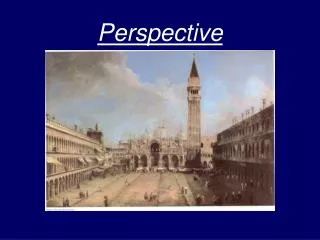
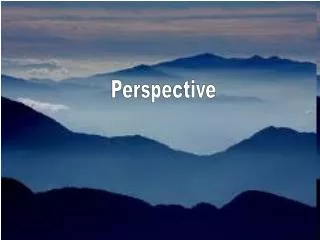
Atmospheric/Optical-The effect of air and light on how an object is perceived by the viewer. The more air between the viewer and the object the more the object seems to fade, bright objects appear closer, duller objects appear farther away. Value or Color: Generally darker values appear closer. Detail: Objects in the foreground have more detail, the farther away an object is the less detail is seen. Overlapping: objects in the foreground cover part of the objects behind them Position: Objects in the fore ground are placed lower on the picture plane. Size: Objects appear to get smaller as the get farther away.
Atmospheric Perspective optical perspective Detail and size change overlapping and placement
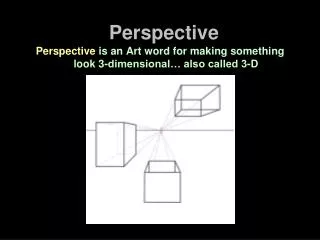
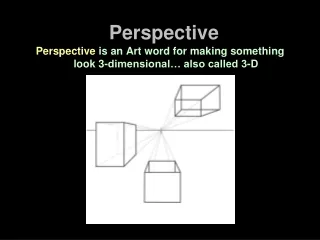
Eye level line/ the imaginary line representing the viewers eye in relation to what they are viewing Vanishing point/ point at which all parallel lines appear to converge in the distance Receding/ moving away from you Advancing/ moving toward you Ellipse/ slightly squashed circle Parallel/ lines the same distance apart moving in the same direction. Converge/ to come together Horizon/ where sky and ground appear to meet in the distance.
1pt..2pt..3pt..4... linear perspective