Team Maus
Discover how our team, comprising Joe Malo, Josh Mele, and Alaric Bobby, tackled maze navigation using a robot tasked with mapping and efficiently traversing random mazes. We implemented strategies based on preference loops, enabling the robot to avoid circular paths while minimizing moves. By creating a matrix to track box encounters, we accurately monitored the robot’s progress. Our research focuses on ensuring prompt return to the start point with the least number of maneuvers as we navigated through complex paths, culminating in a successful, low-move solution.

Team Maus
E N D
Presentation Transcript
Team Maus • Team Members • Joe Malo • Josh Mele • Alaric Bobby • Faizaan Mustafa
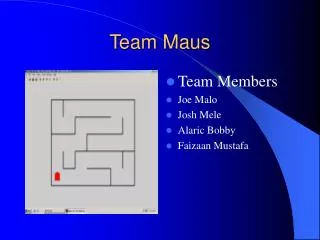
Project Goals • Search or wander the maze. • Build a map of what it sees. • Drop cargo at the end point. • Return to start using the shortest path.
Commands, Output, Scoring • 0 - Go forward one unit • 1 - Turn left 90o • 2 - Turn right 90o • 4 - Play sound • Getting to the top right corner and then back to bottom left with lowest number of moves
Strategy • Assigned specific preferences for the robot to follow. • Used three difference preference loops to tackle the random mazes. • After the robot encountered a box three times it would back track. • After five times it would return to the beginning. • The idea is to avoid the robot from going in circles.
Mapping • The robot starts off by making a 5 x 7 matrix of zeros. • Makes a one for every box it goes in. • Whenever it goes in the same box, it will add another one to that number. • For example, if the robot went into a box 3 times, it would be mapped “3.”
Conclusion • After trying several codes and methods, we found this one to be the most accurate and the fewest moves. • The problem we encountered with our other methods, was the preferences didn’t guarantee a successful run. • Our robot will always return to the start in the least moves possible.