Understanding Subject-Verb and Pronoun-Antecedent Agreement in English Grammar
This grammar practice focuses on the essential rules of subject-verb and pronoun-antecedent agreement. Learn how to appropriately match subjects with their verbs and ensure pronouns agree with their antecedents in number and gender. Exercises cover common pitfalls, including the usage of 'neither/nor' and 'either/or' constructions. Additionally, this practice addresses problematic sentence structures involving dangling and misplaced modifiers, improving clarity and correctness in your writing. Master these concepts for better communication skills!

Understanding Subject-Verb and Pronoun-Antecedent Agreement in English Grammar
E N D
Presentation Transcript
Grammar Practice 7 May 2014
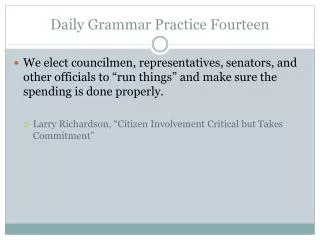
Subject-Verb and Pronoun-Antecedent Agreement • 1. Neither of the teachers (see, sees) those students after school. • sees • 2. Neither Thomas nor his brothers (is, are) going to Chicago. • are • 3. Either of the players (is, are) capable of a home run. • is • 4. Each of the students will take (his, their) test on Friday. • his • 5. One of the books lost (its, their) cover. • its
7. Correct or Incorrect? • Nobody wanted their lunch after seeing that film in science. • The above sentence is incorrect. • Correct: Nobody wanted his (or her) lunch after seeing that film in science. “Nobody” is singular; therefore, you need a singular pronoun “his.” “Their” is plural.
Dangling and Misplaced Modifiers 8. • Peering through the binoculars, hundreds of bats were visible. • Peering through the binoculars, we saw hundreds of bats. 9. • Flying near the ceiling, our class watched the bats. • Our class watched the bats flying near the ceiling.
10. Choose the sentence that is grammatically correct. • Waking up from a three-hour nap Gretchen realized she had overslept. • Waking up from a three-hour nap; Gretchen realized she had overslept. • Gretchen woke up from a three-hour nap and she realized she had overslept. • Waking up from a three-hour nap, Gretchen realized she had overslept.