Download
1 / 10
100 likes | 251 Vues
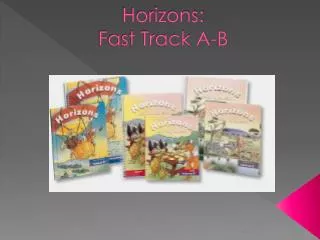
The Horizons Fast Track A-B Program is designed for first graders with foundational letter knowledge and second graders who struggle with reading. This direct instruction program teaches essential decoding and comprehension skills using a structured approach that spans three phases. The curriculum includes comprehensive teacher and student materials, including textbooks, workbooks, stories, and a variety of tools to support learning. By accelerating reading instruction, students can gain two years of reading progress in one year, enhancing their decoding abilities, comprehension, and basic writing skills.

E N D
Program overview • Direct instruction reading program for: • First graders with letter name knowledge • second graders who are non-readers or have poorly developed decoding skills • Teaches decoding and basic comprehension skills
Program components: teacher materials • Presentation books: • Script • Teacher’s guide • Explanation of the program and how to teach it • Placement tests • Word lists • Literature guide • Blackline masters and additional materials to be used with the trade books • Answer key • Contains answers for all student written activities • Audio • Gives instruction on how to present tasks and pronounce the sounds
Program components: student materials • Textbooks • Stories to practice decoding and comprehension • Workbooks • Coordinated with textbook stories • Trade books • Used to reinforce the skills taught
Sequence and structure • Three major phases • Reading tools phase • Phonemic awareness tasks • Letter sounds • Comprehension activities • Begin reading words, phrases or sentences • Prompted reading phase • Reading entire stories • Most text includes a color coded prompting system to support emergent readers • Unprompted reading phase • Read increasing amount of unprompted text • May include some re-reading of previous passages
Why an accelerated reading program? • Provides students with two years of reading instruction in one year • Covers the beginning two levels of reading teaching children how to read well. • Teaches students to have skills to decode passages at a reasonable rate with accuracy • Gives students basic comprehension and spelling skills • Students are able to compose simple sentences and passages
Scope and sequence • Children begin reading words in lesson seven, story segments in lesson seventeen, entire stories in twenty nine. • Many sounds are introduced in the first six lessons. • After lesson ten, a new element is introduced about every third lesson. • Every tenth lesson is a test lesson.
Divisions of lessons • Word attack • Phonemic relationships • Letter identification • Word analysis • Story reading • Decoding and comprehension • Read the story first to decode, read the story second to comprehend • Story extensions • Workbook comprehension activities • Independent work • In workbook • Matching, sentence completion, story questions, coloring rules for finding hidden pictures, cross-out games, writing words for pictures, drawing pictures for words, reading new passages and answering questions about them • Textbook • Spelling • Involves generalized patterns that are associated with the letters and letter combinations that have been introduced.
our evaluation • The nature of the program provides quality instruction for decoding skills, phonemic awareness, and phonics skills. • To address “the big 5” we feel that if you are using this as a replacement for the core curriculum you may need to supplement this program with additional materials.
Suggested enhancements to Horizons • Teacher created templates • Lines of practice • Group games • http://oregonreadingfirst.uoregon.edu/inst_addtl_tools.html